Two Weeks Across Japan - Finding My Way Again
Although I felt better after an early night’s sleep, my mind still felt unsettled the next morning.
Part of it may have been the cough medicine I had taken.
The cold had come unexpectedly. I had not packed my usual medication for this trip, so we ended up buying over-the-counter medicine in Japan instead.
The brand was unfamiliar to me.
Even buying medicine over the counter followed a process that was slightly different from what I was used to. One system was familiar — you would pick the medicine, bring it to the cashier, and they would ask whether you had taken it before. Depending on your answer, they would give warnings or advice.
The other system was new.
For certain medications, we were required to fill out a form declaring that we understood the side effects and risks, especially if we had existing conditions or were taking other medication. The form needed to be signed, a passport copy was taken, and approval was required from a senior pharmacist.
The medicine we bought required both processes.
It also came with clear warnings not to operate heavy machinery, which I understood as a standard caution for drowsiness.
What I did not fully anticipate was how strongly my body would react to it.
A few hours after taking it, I became extremely sleepy.
When I finally fell asleep, it was not a normal rest. It was a deep, heavy sleep — the kind where you wake up feeling as if you have not slept at all. Your body feels awake, but your mind refuses to follow.
I woke up carrying that strange contradiction: physically moving, but still weighed down by exhaustion.
At the same time, my partner had also sustained an injury that limited her movement.
By the night before, we had already decided to skip the next day’s plan.
It was not a difficult decision.
We had been to Fushimi Inari twice on previous trips — once during the day, and once at night, when we climbed all the way to the top.
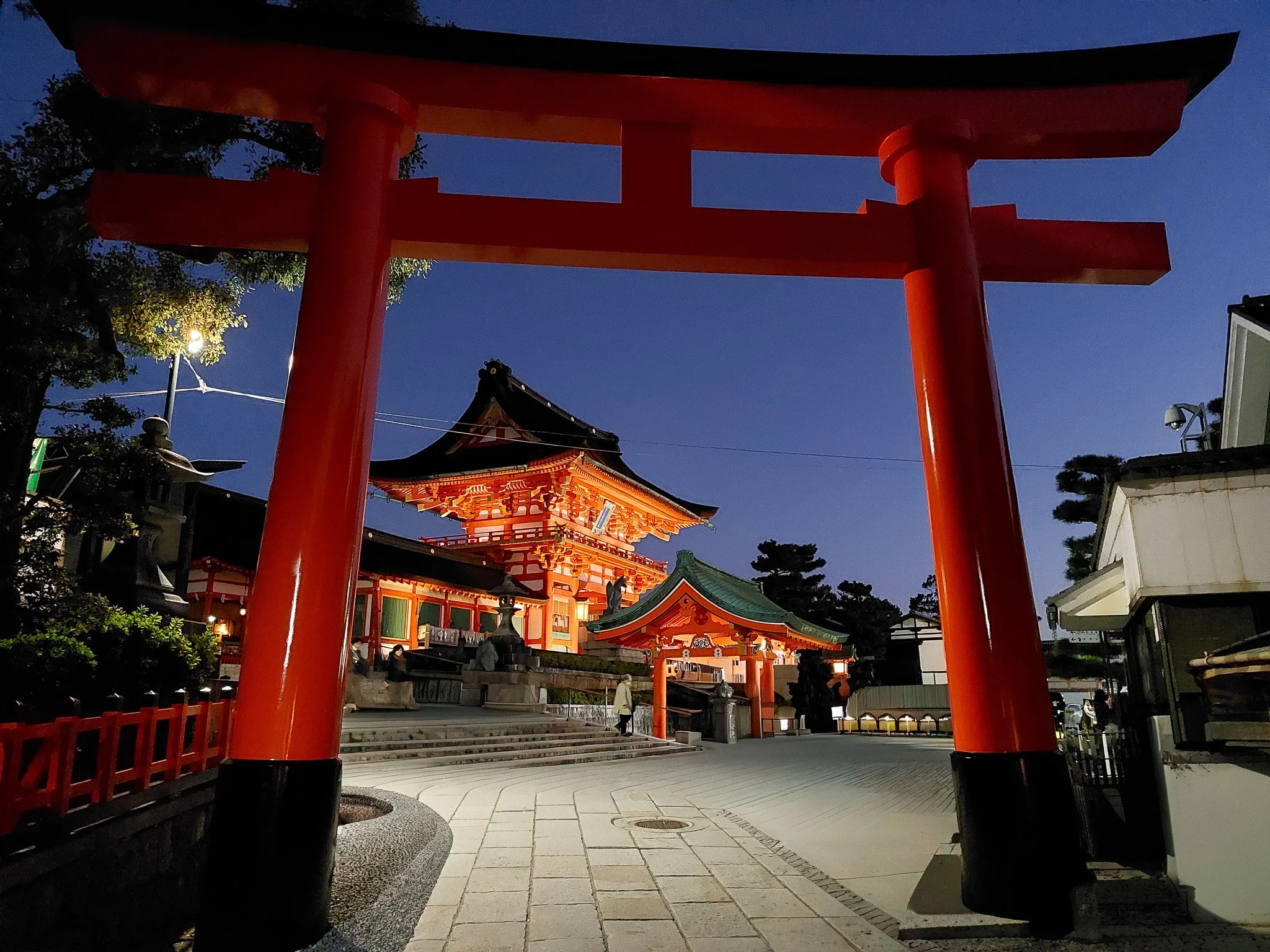
It was the night climb that stayed with me most.
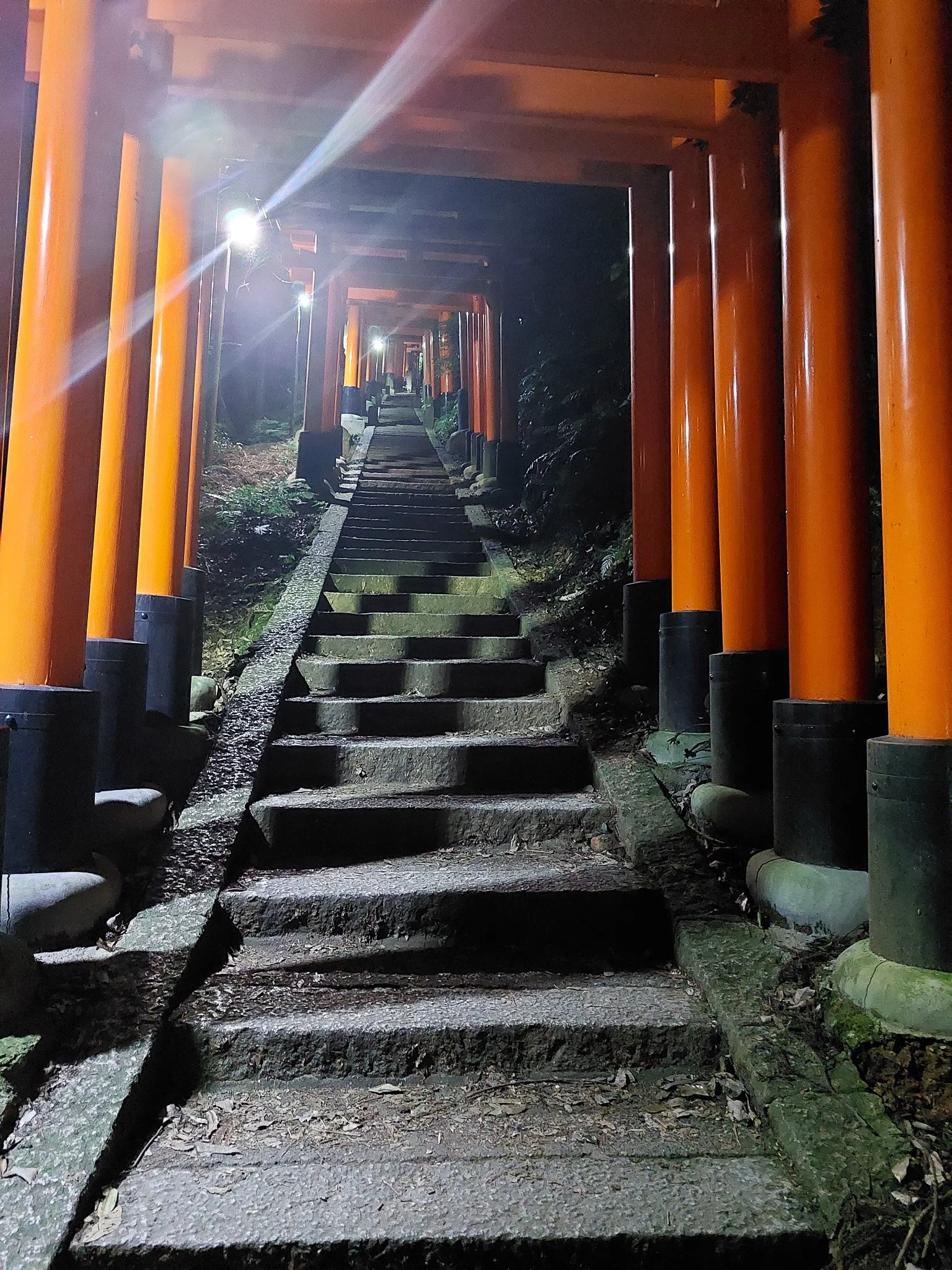
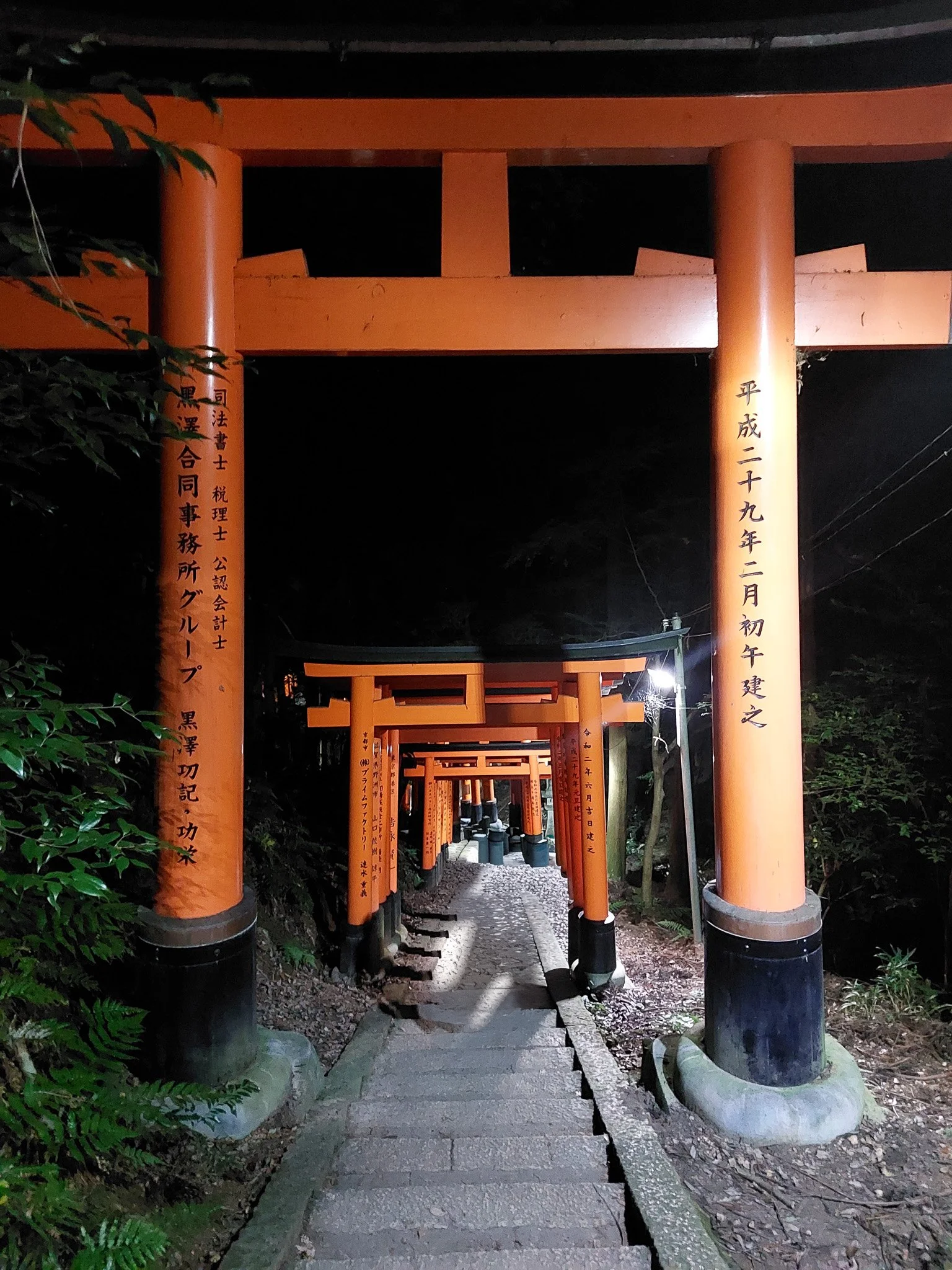
There is something different about Fushimi Inari after dark. The crowds disappear. The path narrows into silence. Most of the time the only light comes from your phone, and even that only reaches as far as your steps allow. The climb becomes less of a sightseeing route and more of a gradual disappearance into darkness.
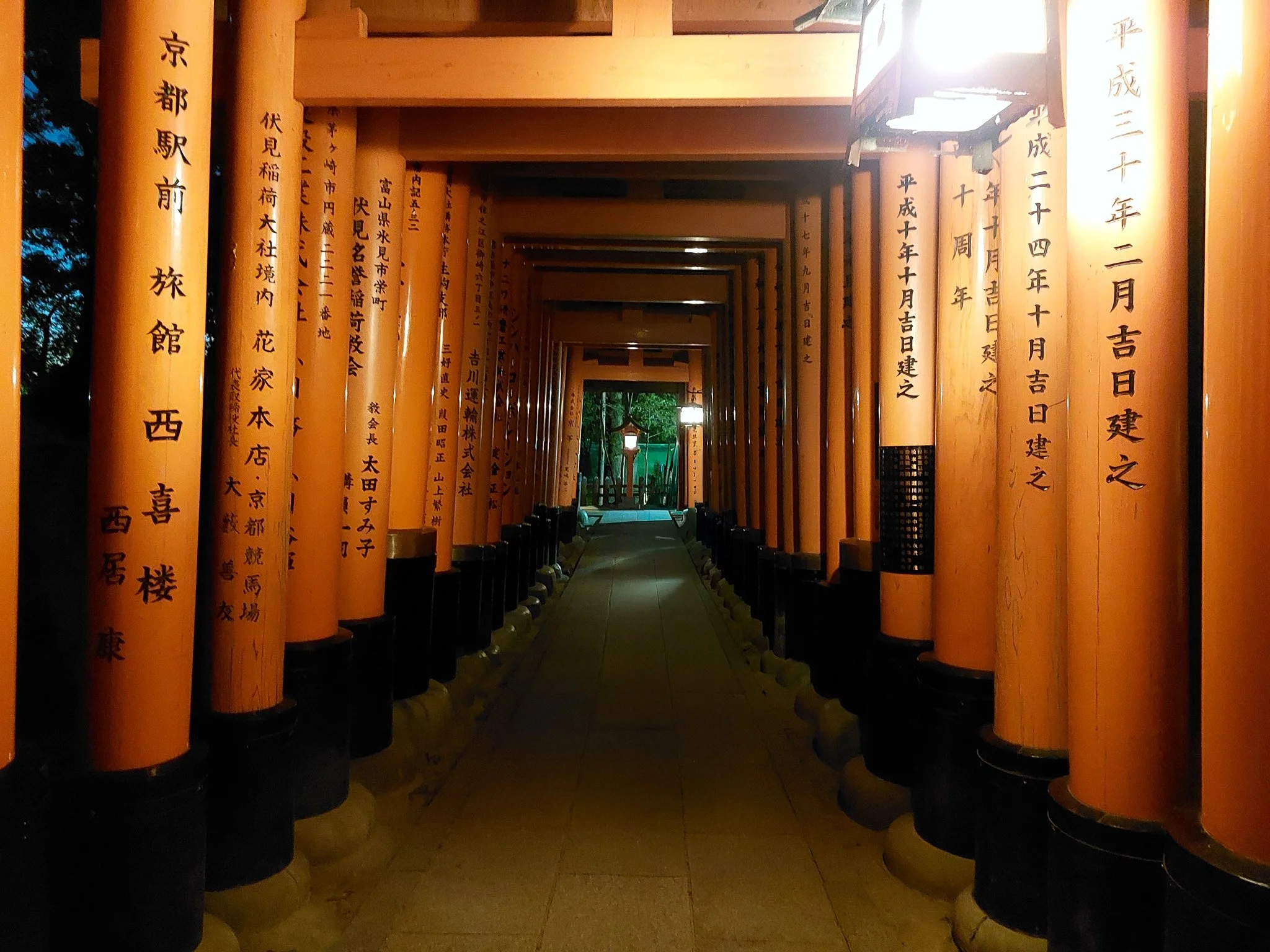
At some point, it turned almost unsettling.
It was so quiet that every sound felt amplified.
Then we heard it — the unmistakable sound of a suitcase being dragged across stone.
At first distant, then closer, echoing behind us through the narrow path.
A young man appeared, moving quickly, pulling a small carry-on suitcase behind him.
He passed without slowing down.
We stepped aside to let him through.
At first, we paid it no attention.
But then something felt strange.
The sound simply stopped.
No turning corner. No fading distance. Just silence.
We looked at each other, slightly unsettled.
Had he picked up the suitcase? Had he taken another path? Or had something else happened entirely?
In the darkness, imagination fills gaps more easily than reason.
We laughed it off, telling ourselves it was nothing.
But even so, we never saw him again on that climb.
We also chose to skip Uji on this trip.
We had been there before, and it was one of the places we had enjoyed enough to recommend to the group while we were in Osaka.
But this time, it fell away from the plan naturally.
What I remember most about Uji is not a landmark, but a scent — the moment you step into the streets near the river and are met with the smell of roasted green tea. It arrives before anything else, almost guiding you forward.
It is a place that pulls you in through atmosphere rather than intention.
We had experienced tea tasting elsewhere, in Yame, but Uji felt different. Less structured, more immediate — as if tea culture there was not being presented, but simply lived.
With both illness and injury slowing us down, the rhythm of travel shifted.
We moved less decisively, rested more often, and made decisions based not on what was next, but on what was manageable.
I had another task for the day.
Our journey as a group was slowly approaching its end. After walking the Nakasendo Trail, we would part ways. My partner and I would return to Osaka for another two nights before flying home, while the rest of the group would continue on to Tokyo.
Before that happened, I needed to sort out a few practical matters.
I had already booked our hotel in Osaka, but I needed to confirm that they could store our luggage for two nights while we travelled to Nagoya. Just as importantly, I needed to work out how to get there. Between us we had two large suitcases and a carry-on bag, and I wanted to find the easiest route before we had to make the journey with all that luggage in tow.
From the information provided by the hotel and various online sources, there appeared to be three ways to reach it. The most direct seemed to be the hotel transfer bus. The catch was that I first needed to find the pickup point somewhere in Umeda.
That was easier written than done.
Umeda had always felt enormous and confusing to me. Even after previous visits, I never felt entirely comfortable navigating its underground passages and maze-like exits. My plan was simple enough: scout the area now while I had the time, locate the pickup point, and save myself unnecessary stress later.
Fortunately, while I had little interest in dinner the night before, I had used the time for something unexpectedly useful.
I had spent much of the evening staring at my phone, trying to understand why both Google Maps and Google Translate had suddenly stopped working.
I was certain they had worked earlier in the trip.
Something had changed, but I could not figure out what.
I checked settings after settings, looking for anything I might have accidentally switched on or off. My instinct kept returning to permissions and access rights. For some reason, I felt the apps no longer had the access they needed. The problem was discovering where that change had occurred.
With nothing else to do, I kept searching.
Then, like a light bulb switching on, I found it.
It was indeed an access setting.
The moment I reset it, both apps sprang back to life.
The relief was immediate.
I knew I would be on my own the next day, relying heavily on both navigation and translation. Suddenly having them available again felt like regaining two travelling companions I had been missing for days.
It was the second time on the various trips I have taken that technology had failed me, and somehow managed to recover just when I needed it most.
I left my partner resting in the apartment, promising that I would return as soon as possible so we could spend the afternoon together once she had recovered a little more.
The excursion felt strangely familiar.
For the first time on this trip, I would be travelling alone.
It reminded me of earlier journeys when every decision, every wrong turn, and every discovery belonged entirely to me.
From experience, I knew that directions in Japan were usually best followed exactly. Even a small deviation could cost considerable time and leave you approaching a destination from entirely the wrong direction.
That was the theory.
In reality, I almost got lost the moment I stepped out of the ticket gates at Osaka Station.
Fortunately, Google Maps was now working.
Between the station signage and the navigation on my phone, I gradually found my way towards the pickup area. Along the way I took photos of landmarks and signs, creating a visual trail that I could follow later when we returned with our luggage.
I felt quietly pleased with myself when I finally arrived.
The feeling did not last long.
The online instructions showed a clear sign for the hotel transfer bus.
I could not find it anywhere.
I was reasonably confident that I was standing in the correct area. The problem was that dozens of buses used the same terminal. Every route had its own stop, each marked by its own sign.
I walked the area once.
Then again.
Carefully reading every sign.
Nothing matched what I was looking for.
Eventually I approached a construction worker directing trucks in and out of a nearby work site.
He pointed confidently towards the opposite side of the terminal.
The same side I had just come from.
I hesitated, double-checked, and received the same confident answer.
So I backtracked.
When I arrived where he had indicated, I still could not find the sign.
I asked another passer-by.
This time I was directed towards a particular stop.
Looking at the sign, I was convinced it was wrong. There was no mention of a hotel transfer bus.
Only when I stepped closer did I notice a small printed timetable attached to the post.
That was it.
I had been searching for a large sign.
In reality, the only indication was a simple timetable.
And to make matters worse, I had missed the bus by only a few minutes.
Normally the service ran every thirty minutes, but around midday there was a large gap in the schedule. The next bus would not arrive for another two hours.
I stood there for a moment, disappointed.
Not because I had failed to find the stop.
I had found it.
Just slightly too late.
Travel often seems to work that way. You can spend an hour solving a problem only to discover that the final outcome was determined by a few minutes.
With no intention of waiting two hours, I abandoned Plan A and moved on to Plan B.
The subway.
Finding the entrance to the subway line proved surprisingly easy.
Much easier, in fact, than finding the pickup point for the hotel transfer bus.
Before long I was on the train heading towards the station closest to the hotel.
As the train moved through the tunnels, I found myself reflecting on the directions I had been given. The online advice was both right and wrong at the same time.
It was right because the transfer bus was undoubtedly the most practical option. Once on board, there was very little that could go wrong. The bus existed for one purpose only — to take guests directly to the hotel. There was no need to worry about transfers, exits, or whether you had boarded the correct train.
But it was also wrong.
The instructions assumed that finding the pickup point was straightforward. They failed to mention how difficult that part could be. The signage was almost non-existent, or perhaps it had changed since the directions were written. Either way, locating the bus stop turned out to be the hardest part of the journey.
The subway presented a different challenge.
Finding the correct entrance underground was rarely straightforward, especially around major stations like Umeda. Even once aboard the train, there was always a degree of vigilance required. Missing a stop, choosing the wrong exit, or emerging onto the wrong street could quickly turn a simple journey into a confusing one.
Japan's rail network is remarkably efficient, but for newcomers it can also feel overwhelming. Large stations operate like underground cities, and in busy places the pace of movement can be relentless. If you are tired, distracted, or unwell, it can become surprisingly draining.
Fortunately, the station nearest the hotel was much smaller.
Finding the recommended exit was easy enough.
The moment I stepped onto the street, however, my confidence disappeared again.
Google Maps was now working, yet I still found myself hesitating.
I would walk a few steps forward and the arrow would point one way. I would stop, and it would shift again. Sometimes I stepped back only to see the direction change once more.
Before this trip, I had assumed I was unusually bad at following Google Maps. But travelling with others had taught me otherwise. Almost everyone, at one point or another, experienced the same uncertainty.
Digital maps are not quite like printed maps.
A printed map remains fixed. Google Maps constantly adjusts itself according to your position, orientation, and movement. Sometimes that makes navigation easier. Other times it introduces doubt.
Not trusting my own interpretation any longer, I stepped into what appeared to be a consultation office where a woman was working alone.
I showed her the address.
Without hesitation, she took out her phone, searched for the location, then walked outside with me and pointed in the correct direction.
It was a simple act of kindness, but one I appreciated immensely.
Following her instructions, I continued on.
This time, Google Maps seemed content. The arrow remained steady and aligned with the path ahead.
As I approached the location, however, a new problem emerged.
I could not see the hotel.
Instead, I found a building that looked more like an office complex. The name displayed outside partially matched the hotel's name, but not entirely. Unsure, I walked inside.
The lobby was empty.
There was no reception desk. No guests. Nothing that suggested it was a hotel.
Frustrated, I stepped back outside and continued searching, consulting Google Maps every few minutes.
Eventually, I found it.
After confirming that the hotel could store our luggage during our Nakasendo trip, I began walking back towards the station.
Then I looked back.
And immediately saw what I had missed.
The hotel's name was displayed prominently at the top of the building in large letters.
From the entrance of the street, it was perfectly visible.
I simply had not looked up.
The realisation made me laugh.
I had become so focused on the map in my hand and the signs at eye level that I had forgotten one of the first lessons travel had taught me years ago: when lost, stop and look everywhere.
Up. Down. Left. Right.
I had been lost countless times on previous journeys, yet experience had usually taught me to pause and take in the bigger picture before acting.
This time, fatigue, the cold, and perhaps the medication had clouded that instinct.
Instead of observing my surroundings, I had been reacting only to what was directly in front of me.
It was a small mistake, but a useful reminder.
Sometimes the problem is not that the answer is hidden.
Sometimes it is simply that we have stopped looking beyond what is immediately before us.
By the time I returned to Umeda, I had only one objective left.
Lunch.
After that, I intended to head straight back to the apartment.
Finding lunch, however, proved more difficult than expected.
It seemed there was some unwritten law of the universe at work. When you are not looking for something, it appears everywhere. But the moment you actively search for it, it disappears completely.
Restaurants had been everywhere throughout the trip.
Now that I actually wanted one, none seemed to appear.
Part of the problem was that I had no particular meal in mind. Had I been craving ramen, curry, or tonkatsu, I could have searched for it directly. Instead, I simply wanted lunch.
And that left too many possibilities.
So I did what I often do when I have no clear plan.
I let my feet decide.
Before long, I found myself emerging from yet another underground exit that was almost certainly not the one I intended to take.
By this stage of the trip, that was becoming something of a pattern.
I had a vague sense that I was moving away from the main part of Umeda, but instead of turning around immediately, curiosity kept me going. I wanted to see where the passage would lead.
Eventually it led nowhere useful.
Ahead was effectively a dead end. The only options were to return the way I had come or go up to street level.
I turned back.
Halfway along the corridor, I changed my mind and climbed the stairs instead.
The moment I emerged onto the street, I knew I was somewhere unfamiliar.
I did not recognise the road.
Looking up, I could not see any of the landmarks that normally helped me orient myself in Umeda. Tall buildings surrounded me, but none felt familiar.
For the first time that day, I was genuinely lost.
Not slightly misplaced.
Lost.
To make matters worse, there was not a single place to eat in sight.
For a moment, I considered admitting defeat and returning underground. The sensible option would have been to retrace my steps all the way back to the station and start again.
But another part of me resisted.
Perhaps it was the same part that had drawn me to solo travel in the first place.
I was alone.
If I became lost, nobody would be inconvenienced but me. If it took an extra hour to find my way back, nobody would be waiting impatiently.
There was a strange freedom in that thought.
So instead of retreating, I decided to keep walking.
Perhaps I would eventually stumble back into a familiar part of Umeda.
Or perhaps I would discover something unexpected along the way.
Not long after, I spotted a McDonald's.
Under normal circumstances, it probably would not have attracted my attention. But throughout the trip I had noticed advertisements for one of their limited-time burgers and had been mildly curious about it.
Curiosity won.
I ordered one and found a seat.
The first bite surprised me.
Everything tasted extraordinarily salty.
At first, I wondered whether it was simply the burger itself. But the more I ate, the more I suspected it was me rather than the food.
I had experienced something similar years earlier during a trip to Indonesia when I had become unwell. Somehow the illness had altered my sense of taste. Foods that normally seemed perfectly balanced suddenly tasted overwhelmingly salty.
This felt much the same.
The burger was probably exactly as intended.
It was my body that was interpreting it differently.
Travel often changes the way we see places.
Illness, I was discovering, could change the way we tasted them as well.
While I was having lunch, I found myself thinking back to past moments of travel.
Not the places themselves, or even the exact timelines of when I had been lost or needed help. Those details blur together over time.
What stays with me are the people.
The brief encounters with strangers whose names I never knew, and whose faces I would likely never recognise again.
Yet their actions remain clear.
There were moments when someone would stop what they were doing just to point me in the right direction, sometimes even walking a short distance with me to make sure I understood.
Times when a stranger offered a ride, simply because they sensed uncertainty in my attempt to find transport.
Moments of shared confusion, where fellow travellers realised I was lost and paused their own journey to help me find mine.
Instances where someone noticed my exhaustion and quietly offered a seat without a word.
Or the simple act of someone running after me to return something I had left behind, without expecting anything in return.
None of these people stayed in my life beyond those brief exchanges.
And I prefer it that way.
Some encounters are not meant to continue. They are complete in the moment they happen.
Occasionally, a few might turn into friendships, or lead to future contact. But more often than not, they remain exactly as they were — brief intersections between strangers.
I do not remember their names.
I do not remember their faces clearly.
But I remember how they made me feel.
And perhaps that is what travel gives me most consistently.
Not just the places I visit, but the quiet kindness of people who appear for a moment, help without expectation, and then disappear back into their own lives.
Those moments stay with me longer than any landmark.
I could remember how, but I did find my way back to the station without wasting much time.
Taking advantage of having the afternoon to ourselves, we returned to Shinsaibashi.
This time, we had a purpose.
There were a few specific things we wanted to buy, and we already knew which shops stocked them. The experience was completely different from the previous day. Instead of drifting from store to store and browsing without intention, we moved with efficiency. Into a shop, find what we wanted, then back out again while largely ignoring everything else.
It felt strangely satisfying.
Perhaps because, after days of following the interests and pace of a larger group, we had slipped back into a rhythm that felt more familiar to the two of us.
With the rest of the group still away on their excursion, we decided to have dinner together.
The choice was easy.
We would have the chicken wings.
The decision had been made long before we arrived in Osaka.
On our previous trip, friends who had lived in Nagoya had insisted that we try the famous chicken wings from Sekai no Yamachan. While visiting Nagoya, we tracked down one of their restaurants, only to discover that there was a wait for a table.
Unfortunately, we did not have the luxury of time.
Our train back to Osaka was leaving soon.
So we did what seemed most practical at the time.
We ordered takeaway.
Standing on the street outside, backpacks beside us and one eye occasionally checking the time, we ate the wings there and then.
Perhaps it was the circumstances. Perhaps it was the anticipation that had built up from searching for the restaurant. Or perhaps the wings were simply that good.
Whatever the reason, they left a lasting impression.
The skin was crisp, the meat tender, and the seasoning unlike anything I had tasted before. The pepper was the first thing I noticed. It was peppery, certainly, but not in the way I expected. It carried a balance of savoury, spice, and something almost addictive.
Each bite seemed to invite the next.
Before long, the entire serving had disappeared.
The restaurant was famous for what it called its Phantom Chicken Wings, and after trying them, I could understand why.
When we later discovered there was a branch in Shinsaibashi, we made a mental note.
One day, we would come back.
And now we had.
The restaurant was exactly where I remembered it.
Its entrance remained surprisingly modest, almost easy to miss if you were not looking for it. We were also surprised by how quiet it was. On our previous visit, simply getting the wings had felt like a small challenge. This time, we were shown to a table almost immediately.
As I looked through the menu, I noticed there were dishes I did not remember seeing before.
But none of that really mattered.
We already knew what we were ordering.
When the chicken wings arrived, they looked exactly as I remembered.
Then I took the first bite.
And just like that, the memory returned.
Not as a thought, but as a feeling.
It was as though the taste had been sleeping somewhere in the back of my mind, waiting years for the right moment to wake it up. Suddenly I was back in Nagoya again, standing outside the restaurant with a takeaway box in my hand, eating hurriedly before catching a train.
The remarkable thing about food is that it can preserve memories in a way photographs sometimes cannot.
A picture may remind you what a place looked like.
A familiar taste can remind you exactly how it felt.
The group came together again the next morning, moving as one for what would be our last full stretch in Osaka before the trail.
I had already sorted my luggage the day before, leaving behind only what I needed for the Nakasendo walk. The rest of the group still had theirs to deal with. They faced a choice — carry everything with them to Nagoya and onward to Tokyo, or send them ahead from Osaka.
Taking large luggage through the trail would have been a burden. Our stay in Nagiso was not a hotel, just a small rented house, which meant there would be no reception, no staff, no one to receive bags on our behalf.
This was where one of Japan’s quiet brilliance in travelling revealed itself again.
Luggage forwarding.
It is such a simple system, yet it changes everything. The freedom of moving lightly through cities and trails, knowing your belongings are already waiting at the next destination. In Japan, there are countless places offering this service, but like many things here, knowing the right process makes all the difference.
One of our group had done it before, so naturally she became our guide in this little operation. She knew the usual rates, the safer options, and the practical shortcuts.
That morning, we made our way to the Osaka branch of the same hotel chain they would be staying at in Tokyo. Sending luggage within the same hotel network was the safest choice — an internal transfer, less risk, and often cheaper.
It was one of those travel lessons that feels small when you learn it, but later could become invaluable.
With that sorted, we turned our attention to lunch.
This lunch had been decided long before we even arrived in Japan.
Gyukatsu.
Japanese deep-fried beef cutlet.
It was one of those meals that had been floating in our conversations for weeks, almost becoming part of the itinerary itself.
The restaurant we had in mind was Gyukatsu Motomura in Namba. We knew it was popular, especially for dinner, so all advice pointed to one strategy: queue before opening at eleven.
We arrived early.
And there was already a line.
That should have been our first clue.
We joined it anyway.
People at the front were holding menus, studying them carefully. We looked around for spare menus but could not find any. Shortly before opening, staff came out, collecting menus and guiding people inside.
Those still waiting were asking questions, and the only word I kept catching was tendon.
Tendon?
I found that odd.
Why would a gyukatsu place suddenly specialise in tendon?
For a moment I thought maybe it was a seasonal special.
Only when we finally got hold of a menu did the truth hit us.
Wrong restaurant.
Not gyukatsu.
Beef tendon.
We had spent forty-five minutes queuing for the wrong place.
Across the street, almost mocking us, was the real Gyukatsu Motomura.
Its entrance disappeared underground, a staircase leading down, lined with people already waiting.
We joined the back of that queue, laughing at our own mistake, the kind of mistake that only seems obvious after the fact.
Travel has a way of humbling your confidence like that.
Not long after, a staff member came up and asked if we would mind moving to another branch nearby. Same menu, same kitchen style, same experience — and seats available sooner.
We agreed.
By the time we sat down, the frustration of the wrong queue had already become part of the story.
Then the meal arrived.
What caught my attention first was not the cutlet.
It was the hot stone.
A small rectangular slab placed in front of me, already radiating heat.
Then came the gyukatsu itself — golden, crisp, sliced into thick strips, the inside still a vivid pink.
The waitress explained how to eat it, but I barely needed to listen. The ritual was already clear.
This was not simply a meal.
It was participation.
I picked up the first piece and laid it onto the hot stone.
The sizzle was immediate.
Sharp, alive, almost theatrical.
A thin layer of oil spread across the stone, glistening under the light as the beef seared. That sound — the crackling of the crust meeting the heat — felt like the real beginning of the meal.
For a few seconds, you control the outcome.
Rare.
Medium.
A little longer.
Your own preference.
I liked that.
The first bite was everything the anticipation had promised.
The crust was delicate, light and crisp, giving way to meat that was soft enough to almost collapse. The beef was rich, but not heavy. The oil was there, but restrained — enough to carry flavour without overwhelming it.
Then came the sauces.
Each one changed the experience slightly. A dab of wasabi sharpened it. The soy deepened it. The cabbage and rice grounded it.
Every bite felt balanced.
Not flashy.
Just precise.
The kind of meal that reminds you why Japan does simple things so well.
By the end of it, the wasted forty-five minutes in the wrong queue no longer felt wasted at all.
If anything, it made the first bite taste better.
Sometimes the journey to the meal becomes part of the meal itself.
The rest of the day was spent wandering through Amerikamura and Orange Street, two places I had never visited before.
I had heard of them, of course. Enough to form some vague idea in my mind of what they might be like. Amerikamura — youthful, trendy, a little rebellious. Orange Street — stylish, polished, where design and fashion seemed to carry more weight. But knowing of a place and standing inside it are always two different things.
Amerikamura struck me immediately.
It was loud.
Not just in sound, but in expression.
The fashion here felt fearless. Bold colours, oversized silhouettes, mismatched layers that somehow worked, heavy boots, chains, piercings, dyed hair in shades that seemed to challenge nature itself. Some outfits looked almost theatrical, like costumes, yet the people wearing them moved with such ease that it was clear this was simply their everyday self.
It fascinated me.
I found myself watching more than shopping.
There was a confidence in it that I admired — the willingness to wear something not because it blended in, but because it stood out. In many ways, it felt like a pocket of Osaka where individuality was worn openly, loudly, almost proudly.
It was modern, restless, and full of energy.
Shop after shop reflected that same spirit. Vintage clothing, streetwear, sneakers displayed like art, accessories that felt more like statements than decoration.
We drifted in and out of them, more out of curiosity than intention.
There was never really a plan to buy.
It was more about understanding the place through what it sold.
Then, gradually, Amerikamura gave way to Orange Street, and the mood shifted.
The change was immediate.
If Americamura was youthful noise, Orange Street felt like composed confidence.
The shops were cleaner, quieter, more deliberate.
Glass fronts, carefully arranged interiors, minimalist displays where every item seemed to have been placed with precision. Here the fashion was still modern, but refined. Less shouting, more whispering wealth.
There were designer labels, premium leather goods, bespoke furniture, curated lifestyle stores — the kind of places where even the empty space seemed expensive.
We moved the same way here too, darting from one shop to another, peering inside, touching fabrics, examining designs, asking ourselves who actually bought these things.
Not us.
But that was never the point.
Like Amerikamura, it was less about buying and more about observing.
Two streets, not far apart, yet they felt like two very different conversations about style.
One loud and unapologetic.
The other restrained and expensive.
Both modern.
Both distinctly Osaka.
And walking between them felt like moving between two versions of the same city — one wanting to be seen, the other already knowing it was.
On our way back to the apartment, we passed the small restaurant near our place — the one we had noticed almost every evening with people queueing outside, especially after 6:30 PM. Throughout our stay, we had joked a few times that we should try it. It was so close, almost at our doorstep, and the steady line of locals every night felt like its own recommendation. If people were willing to wait, it had to be worth it.
That evening, it was only just after 6 PM when we walked by, and for the first time the place looked almost empty.
It felt like a rare opening.
At first, we thought of asking if we could make a reservation for later, maybe 7 PM. But there was no reservation system. If we wanted it, we had to queue. Standing there on the street, with everyone a little tired from the day but not quite ready to end it, the decision came easily.
Why wait?
So we went in.
We were led upstairs to a small dining space and squeezed around a table clearly meant for four, even though there were six of us. The staff offered separate tables, but none of us wanted that. It felt better to stay together, cramped and all, shoulders brushing, bags tucked under chairs, elbows negotiating for space. Somehow it felt more fitting that way.
The restaurant specialised in okonomiyaki.
There was something comforting about that. Of all the food Osaka is known for, okonomiyaki felt like one of its signatures — simple in idea, rich in flavour, built from many ingredients pressed together into one whole. Sitting there, it felt strangely symbolic of our trip itself.
We ordered the house special and asked the waitress for recommendations. One dish became two, then three, until the table was crowded with hot plates, sauces, and the familiar rising steam of a busy meal.
The smell alone was enough to quiet us for a while.
The okonomiyaki arrived sizzling, the sauce glistening under the light, the bonito flakes on top moving as if alive from the heat. The first bite was exactly what you hoped for — soft inside, crisp on the edges, rich with layers of cabbage, batter, seafood, and meat, all tied together by that sweet, savoury sauce.
Every dish that followed was just as good.
And in that moment, the joke we had made all week felt answered.
It was true.
If locals were willing to queue for it, the food must be good.
But more than that, it felt like the right meal to end our Osaka days together.
Not extravagant. Not planned. Just stumbled upon at the right time, close to home, as if it had been waiting for us all along.
In the next following days, the shape of the journey would begin to change. Some would head towards Tokyo. We would return to Osaka again later, but it would no longer be the same group, no longer the same rhythm.
This meal, squeezed around that small table over hot okonomiyaki, became our last shared taste of Osaka.
And somehow, that made it taste even better.