Two Weeks Across Japan - When We learned to Slow Down
Lucky for us, a convenience store sat almost beside the hotel. By now our breakfast habits in Japan had settled into a familiar routine — usually an egg sandwich, sometimes accompanied by a tuna sandwich, and almost always a soft-boiled egg. It was a simple meal, but one that had quietly become part of our rhythm whenever we visited Japan.
We lingered inside while eating, partly to rest our feet and partly because eating while walking is generally frowned upon in Japan. It was only later that we discovered the store charged a different tax rate depending on whether food was consumed on the premises or taken away. Having already finished our breakfast, we collectively decided not to investigate the matter too closely.
With breakfast behind us, we began the journey to Miyajima.
Like many journeys in Japan, it unfolded in stages. First the tram carried us back to Hiroshima Station. From there, the JR train followed the coastline westward to Miyajimaguchi Station, where passengers streamed steadily toward the ferry terminal. A short walk later, we found ourselves joining the queue for the ferry crossing to Miyajima.
There was a faster high-speed ferry available, but after a brief discussion the group decided against it. The savings in time felt difficult to justify when measured against the cost. Besides, there was no particular hurry. The island had waited centuries; it could wait another few minutes for us.
The ferry was already quite full by the time we boarded, and we considered ourselves fortunate to find seats together.
I did not remain in mine for long.
The crossing to Miyajima would take only about ten minutes — barely enough time to settle in compared to the much longer ferry journeys I had taken elsewhere. Only a few months earlier, I had spent hours crossing from Kupang to Flores, watching the sea stretch endlessly towards the horizon. This felt almost fleeting by comparison.
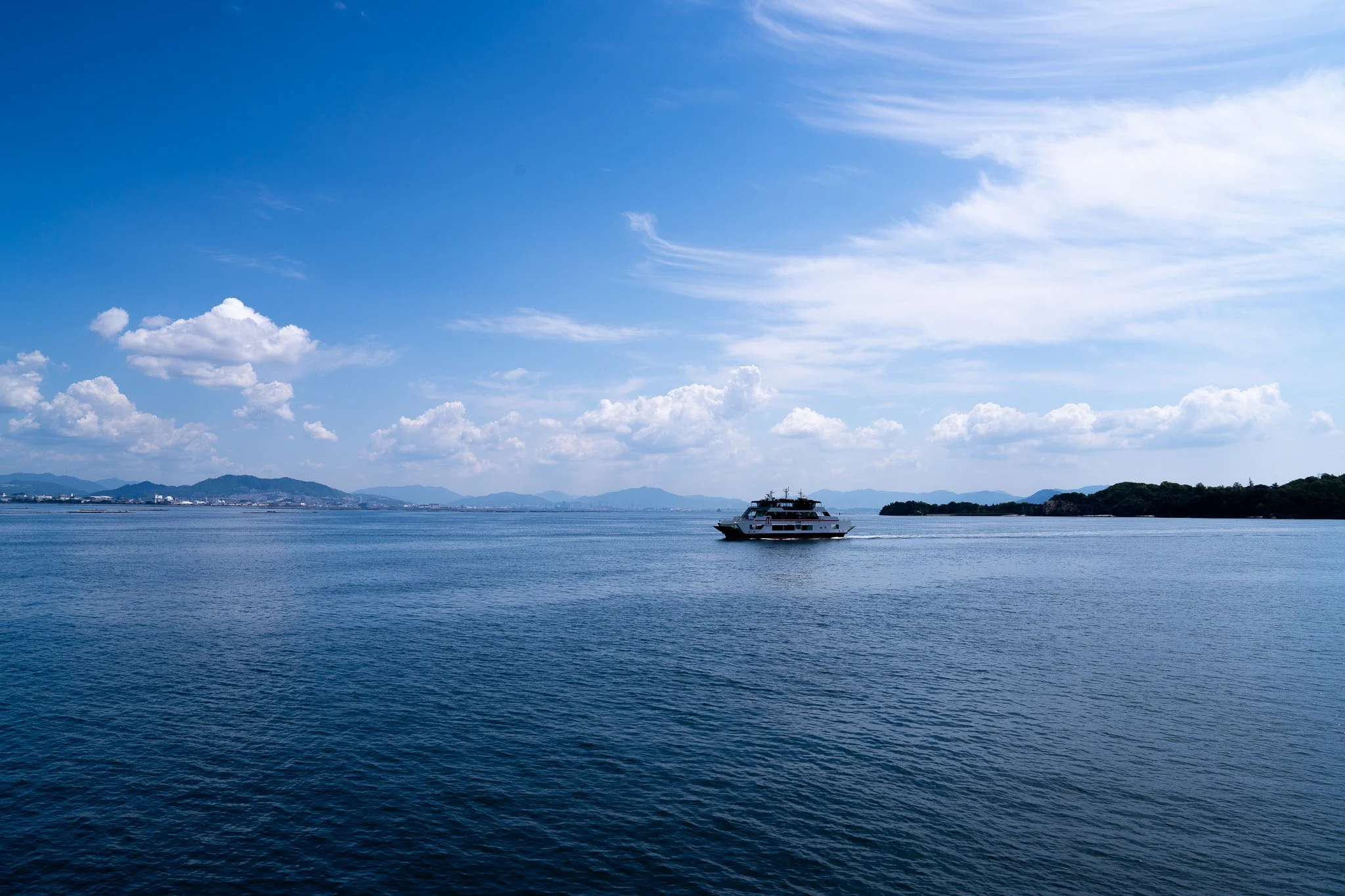
Perhaps because of that recent experience, I found myself wandering around the ferry instead. It was a habit I had unknowingly picked up from that voyage — exploring the different levels, studying the layout, and trying to understand how a vessel functioned beyond simply carrying passengers from one point to another.
Before I realised it, a familiar shape appeared beyond the windows.
The floating torii of Miyajima.
The island's most recognisable symbol stood surrounded by the high tide, seemingly suspended between sea and sky. Even from a distance, it was unmistakable. Yet the ferry passed too far away to truly appreciate its scale or presence. For now, it was merely an introduction — a promise of what awaited us on the island itself.
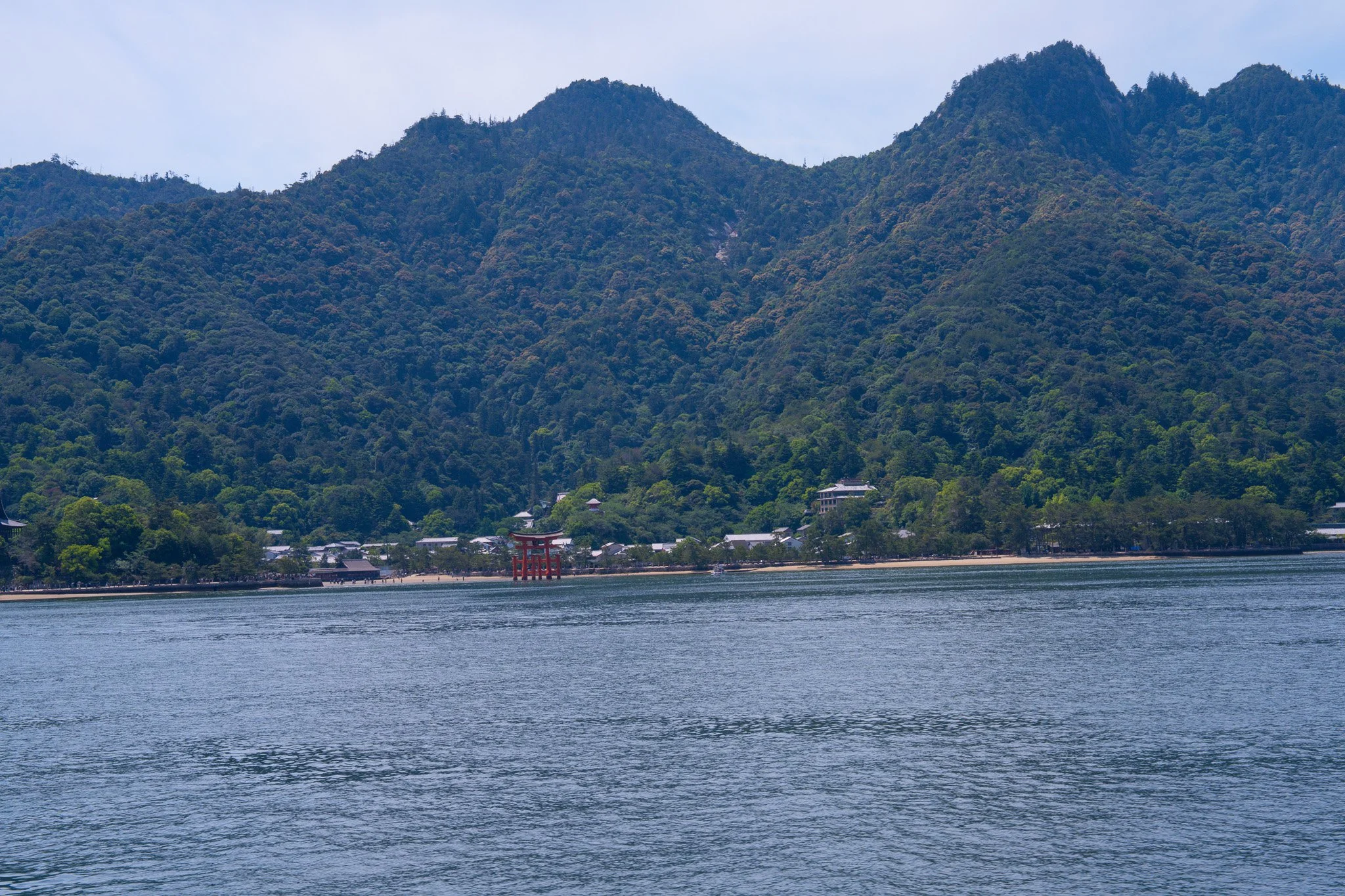
Soon enough, the ferry eased into the terminal and the orderly flow of passengers began moving towards the exit.
Following the stream, we stepped onto Miyajima.
The sun was high and uncompromising. Not a cloud seemed willing to drift across it. The warmth that had been pleasant in Hiroshima quickly became something more insistent, and our first act on the island was not sightseeing but applying sunscreen in the shade.
While we stood there, another of Miyajima's well-known residents appeared.
The deer.
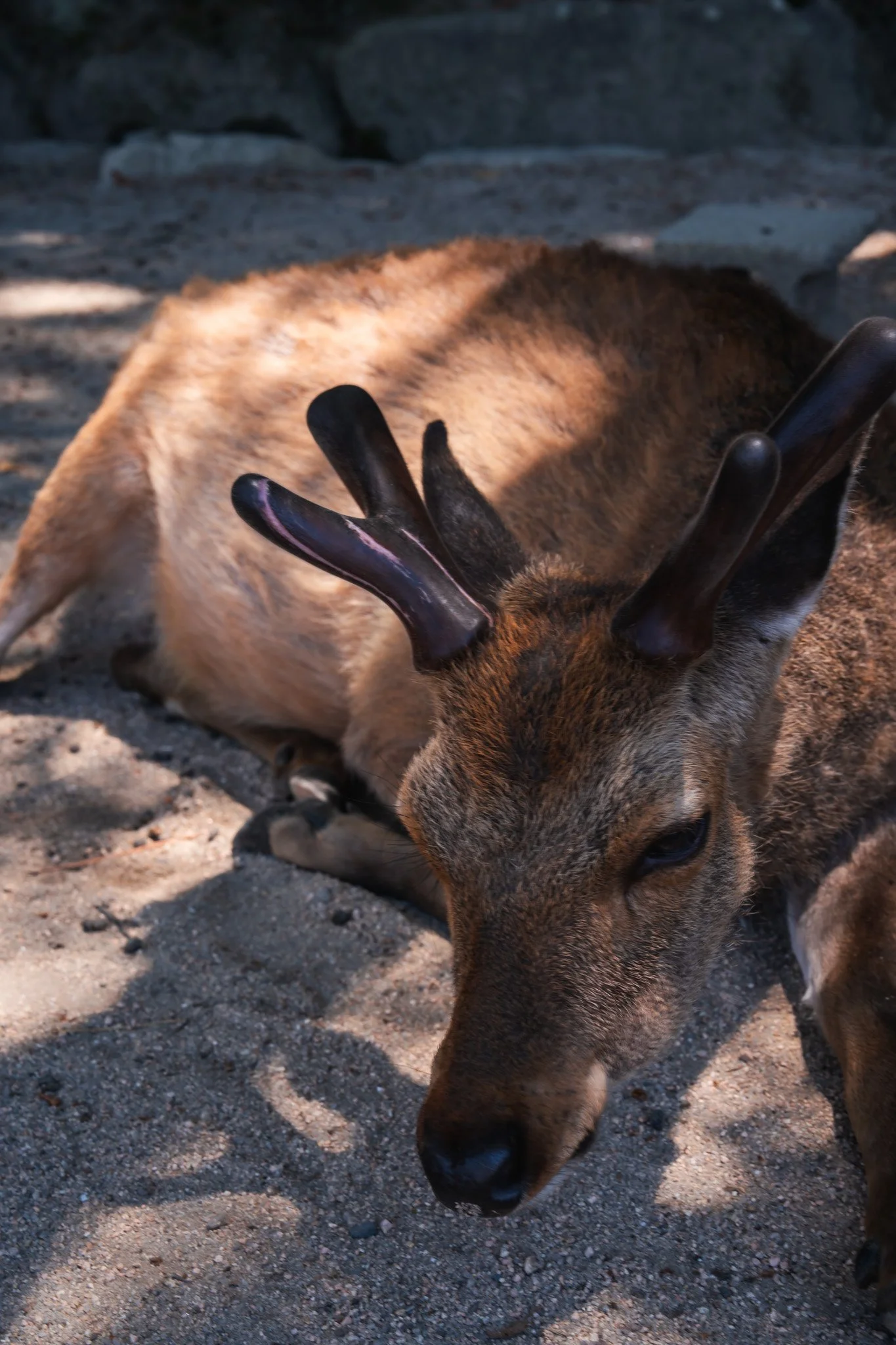
They moved calmly among the visitors, seemingly indifferent to the attention they attracted. Their gentle appearance invited interaction, but signs nearby reminded everyone not to feed them. We obeyed, content simply to watch.
For the moment, observation felt enough.
After all, the island itself was only just beginning to reveal itself to us.
We were not entirely sure where to go first.
The shopping street immediately tempted us. Its rows of shops seemed capable of consuming an entire afternoon if we allowed them to. We knew ourselves well enough to recognise the danger.
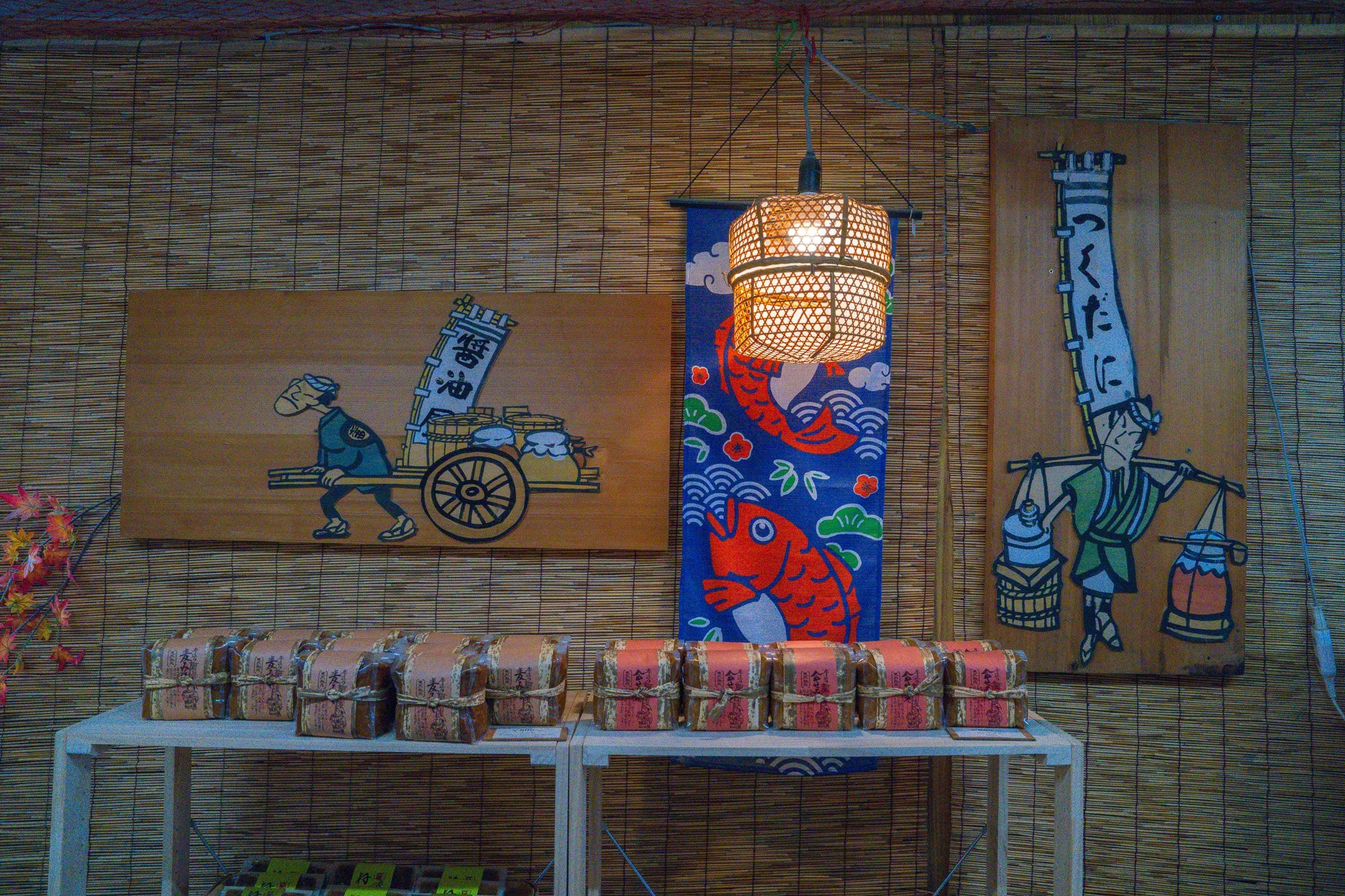
Although the forecast suggested the weather would remain fine for a while longer, rain was expected later in the afternoon. After a brief discussion, we decided to leave the shops for later and make our way towards the torii first.
If the rain did arrive, we wanted to have seen Miyajima's most iconic sight before it did.
The walk itself proved difficult to rush.
As we passed the first row of food stalls and small shops, one in particular caught our attention — a bakery selling beef curry doughnuts. Japanese curry has a flavour all of its own, comforting and familiar in a way that differs from the curries I grew up with. None of us had encountered it inside a doughnut before, which was reason enough to stop and try one.
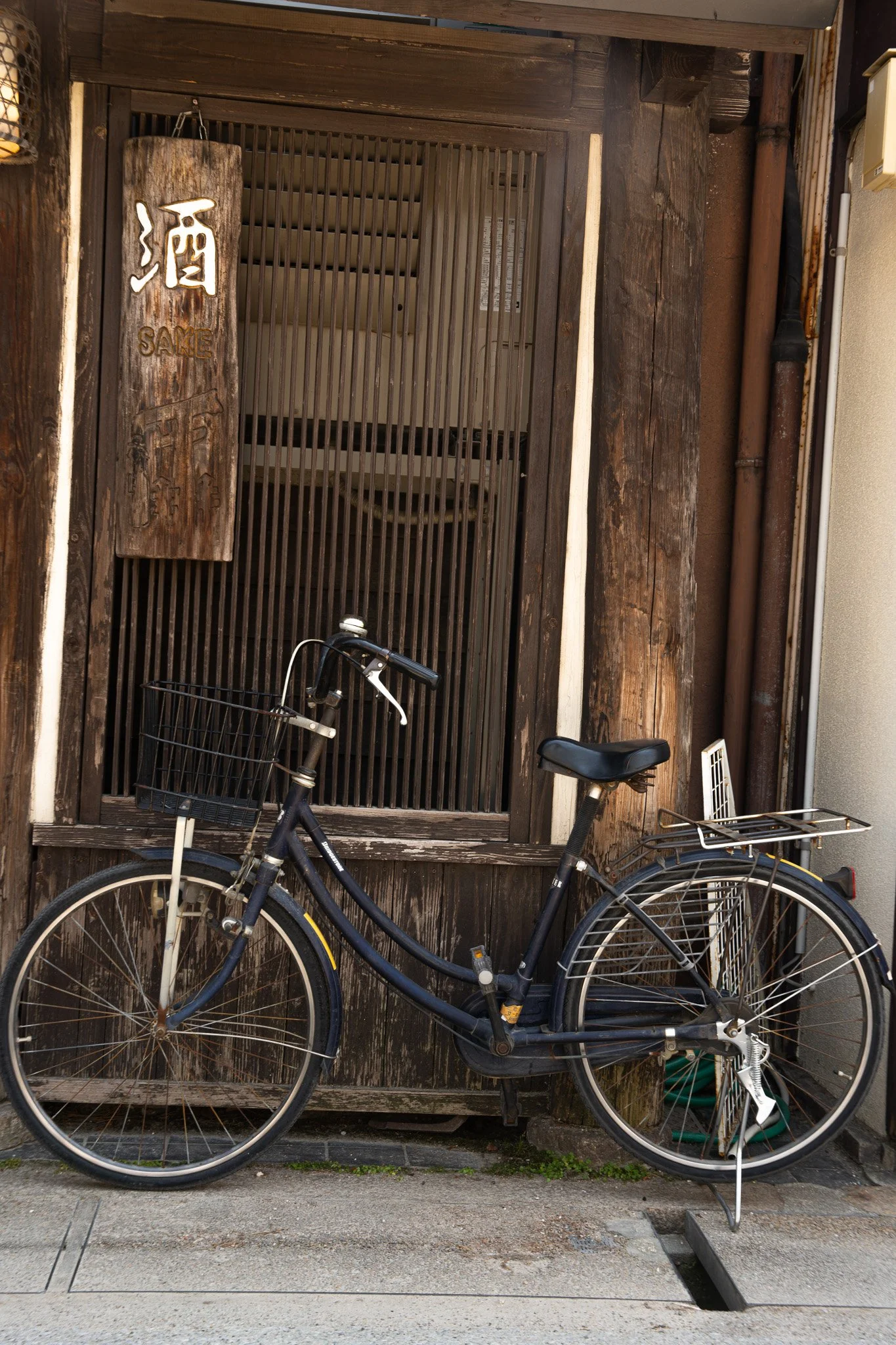
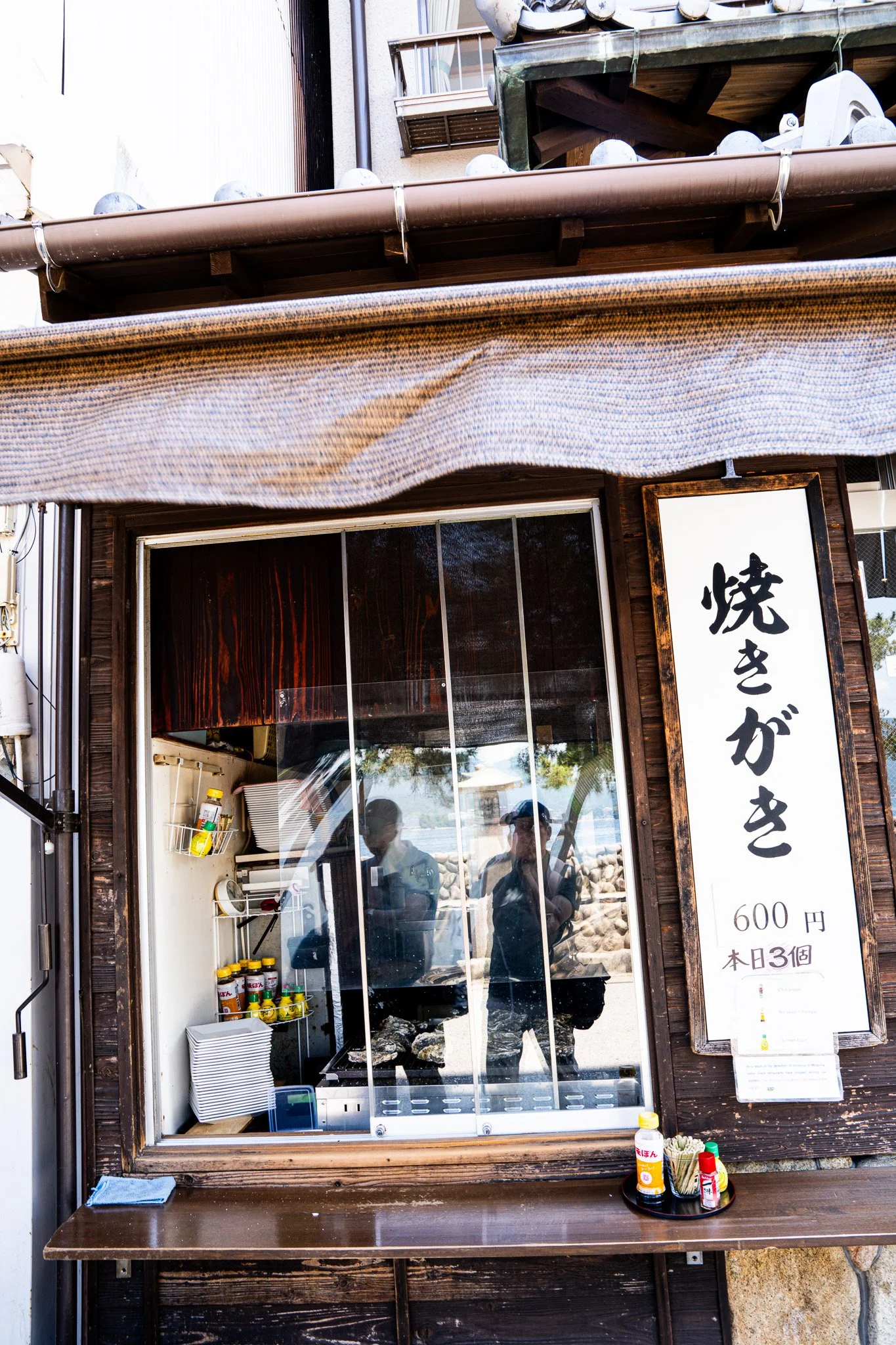
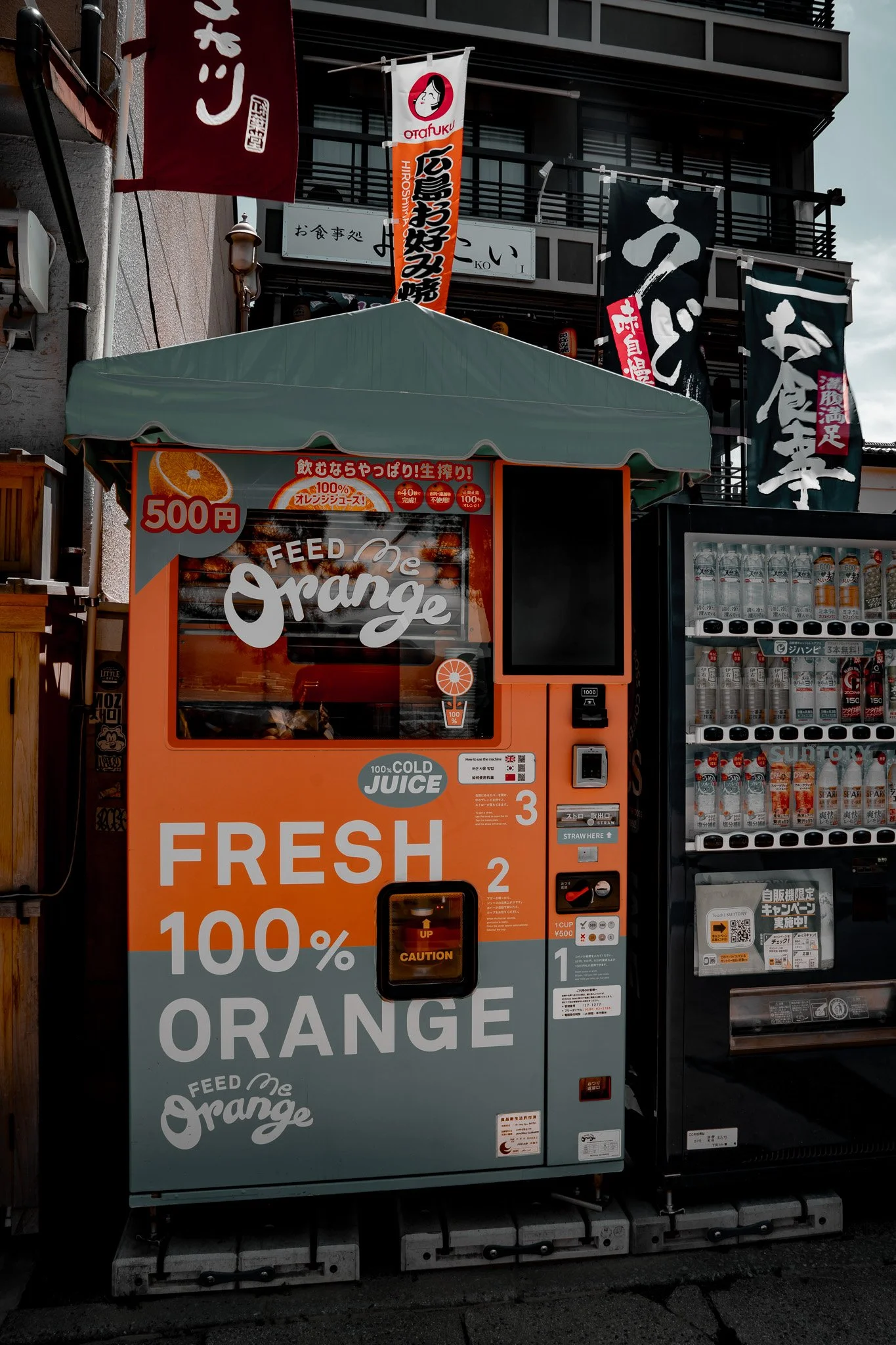
Suitably fortified, we continued towards the shoreline.
As the torii grew larger in the distance, an opportunity presented itself.
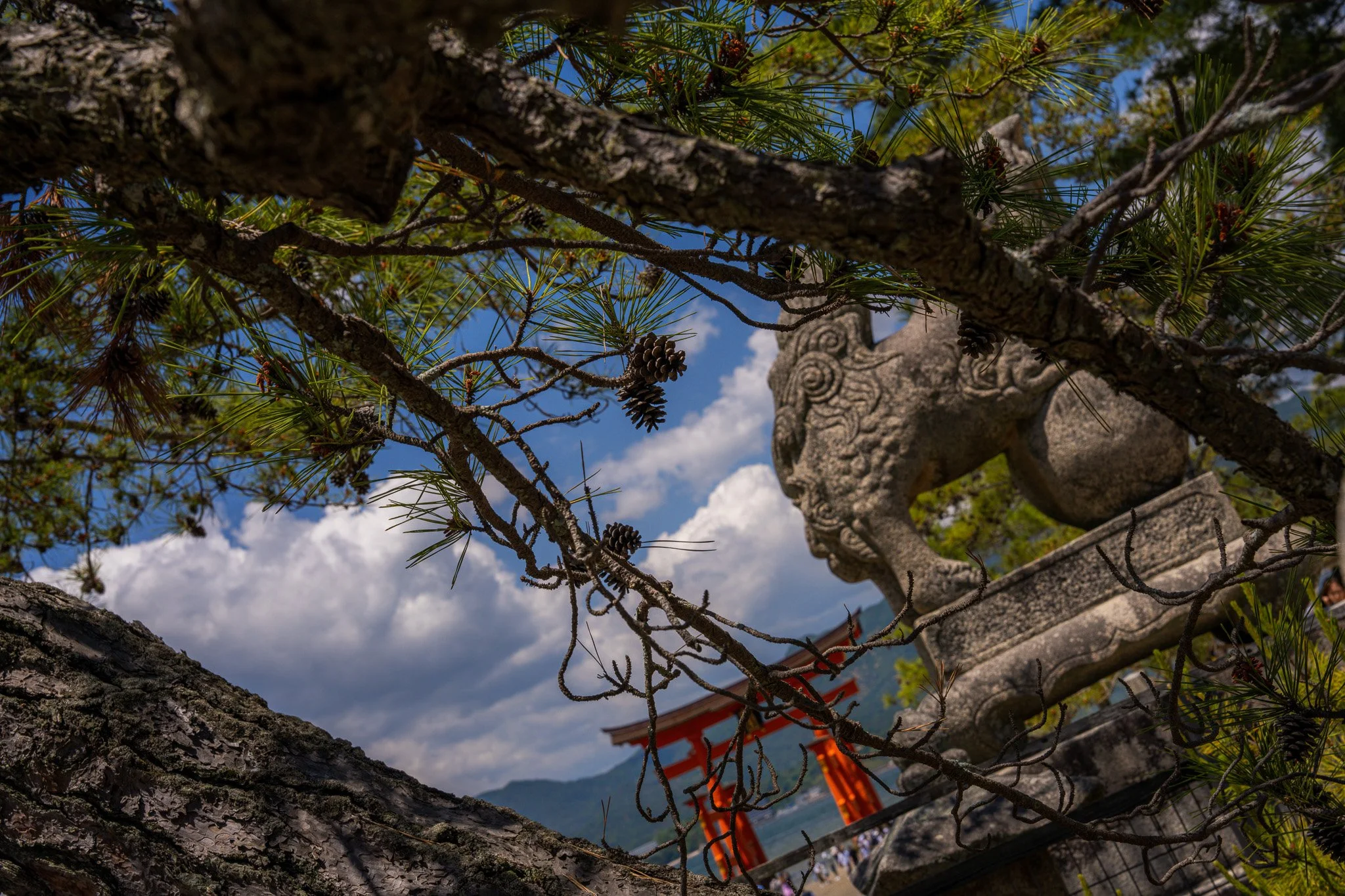
Rather than remaining on the main path, I noticed that the beach offered a clearer approach. The route would bring me closer to the torii and provide an unobstructed view for photographs.
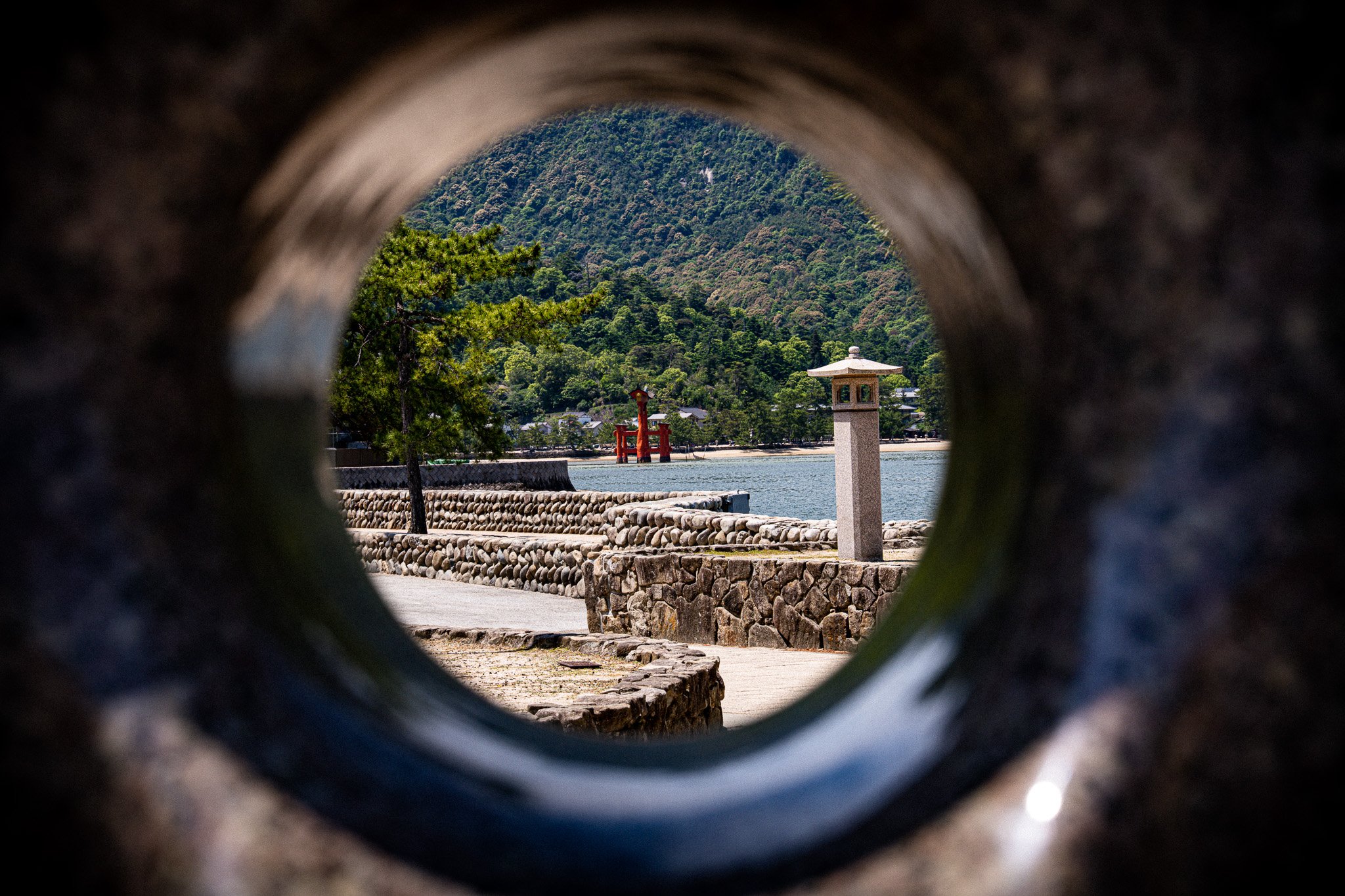
I chose the beach.
A few others followed.
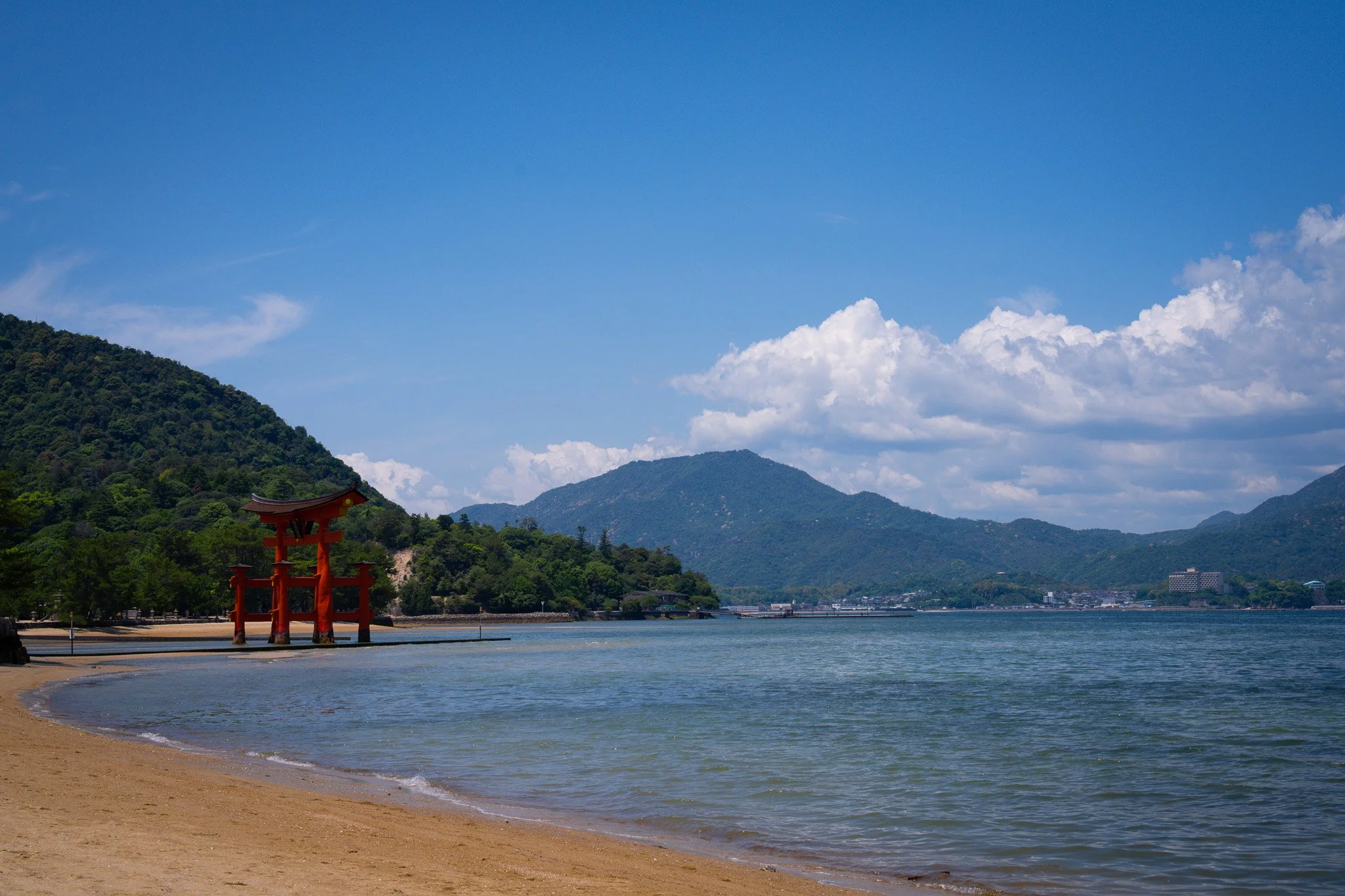
By now the tide had begun its retreat. The water that had surrounded the torii during our approach by ferry had receded significantly, exposing the massive supports beneath. The famous image of the gate floating above the sea had disappeared, replaced by something equally impressive — a structure firmly rooted to the earth, revealing the scale and engineering that usually remained hidden beneath the water.
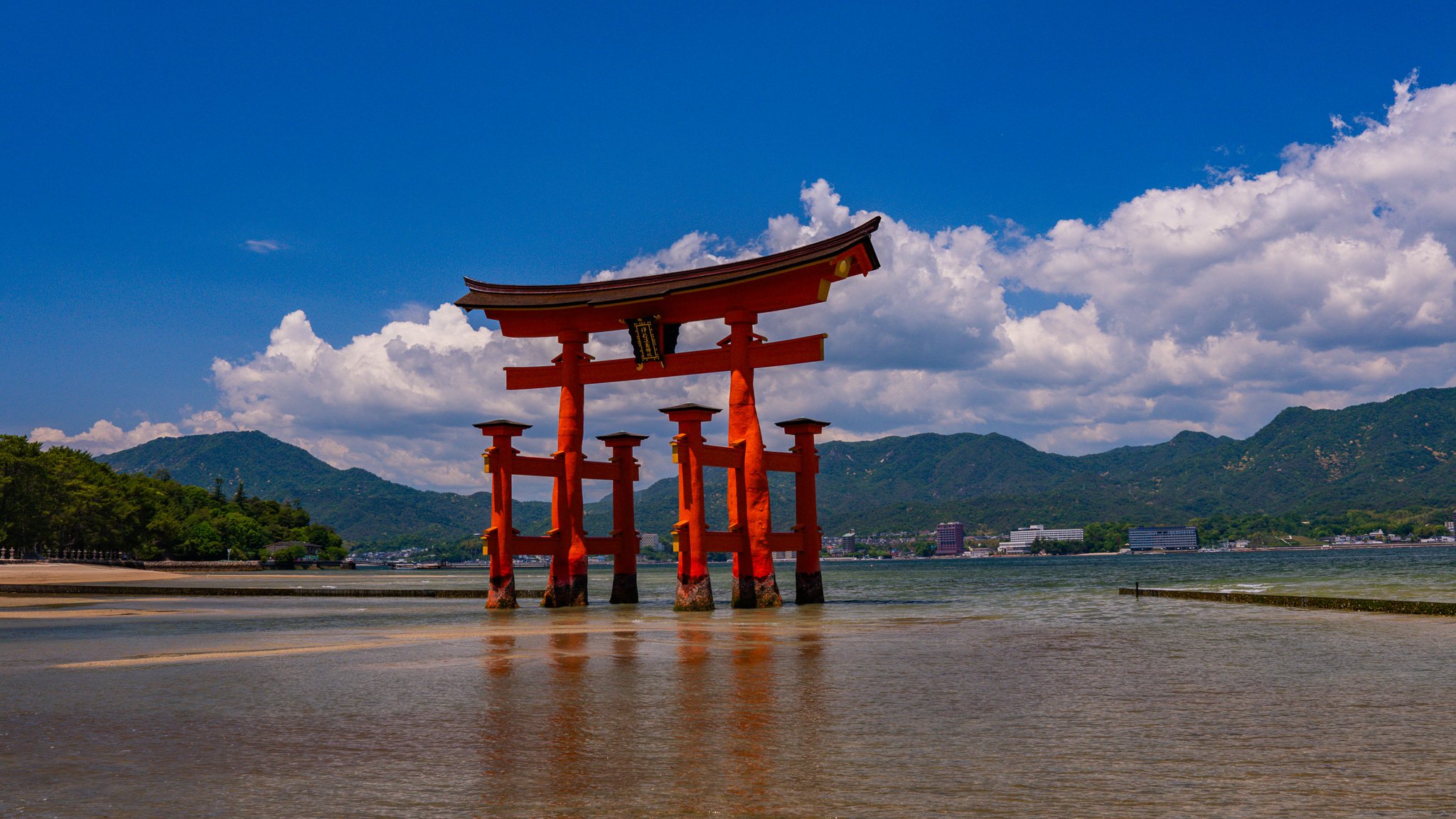
It was different from what I had imagined.
But no less majestic.
As I walked closer, searching for an angle, I realised I was just a little too late.
The first visitors had already begun making their way across the exposed sand towards the torii.
Then another followed.
And another.
Within minutes, what had been an isolated monument became a gathering place.
The scene changed completely.
Of course, nobody was doing anything wrong. The retreating tide had created an opportunity that naturally drew people closer. Had I arrived earlier, I might have done exactly the same.
Still, the photographer in me felt a quiet disappointment.
I had hoped to capture the torii standing alone against the landscape, uninterrupted and timeless. Instead, I found myself sharing the frame with dozens of other visitors.
For a moment, I considered the opportunity lost.
Then I reminded myself that modern photography offered solutions. With enough patience, unwanted figures could be removed later with a few careful edits.
Yet as I stood there watching people wander across the exposed seabed, I began to wonder whether removing them would also erase part of the truth of that moment.
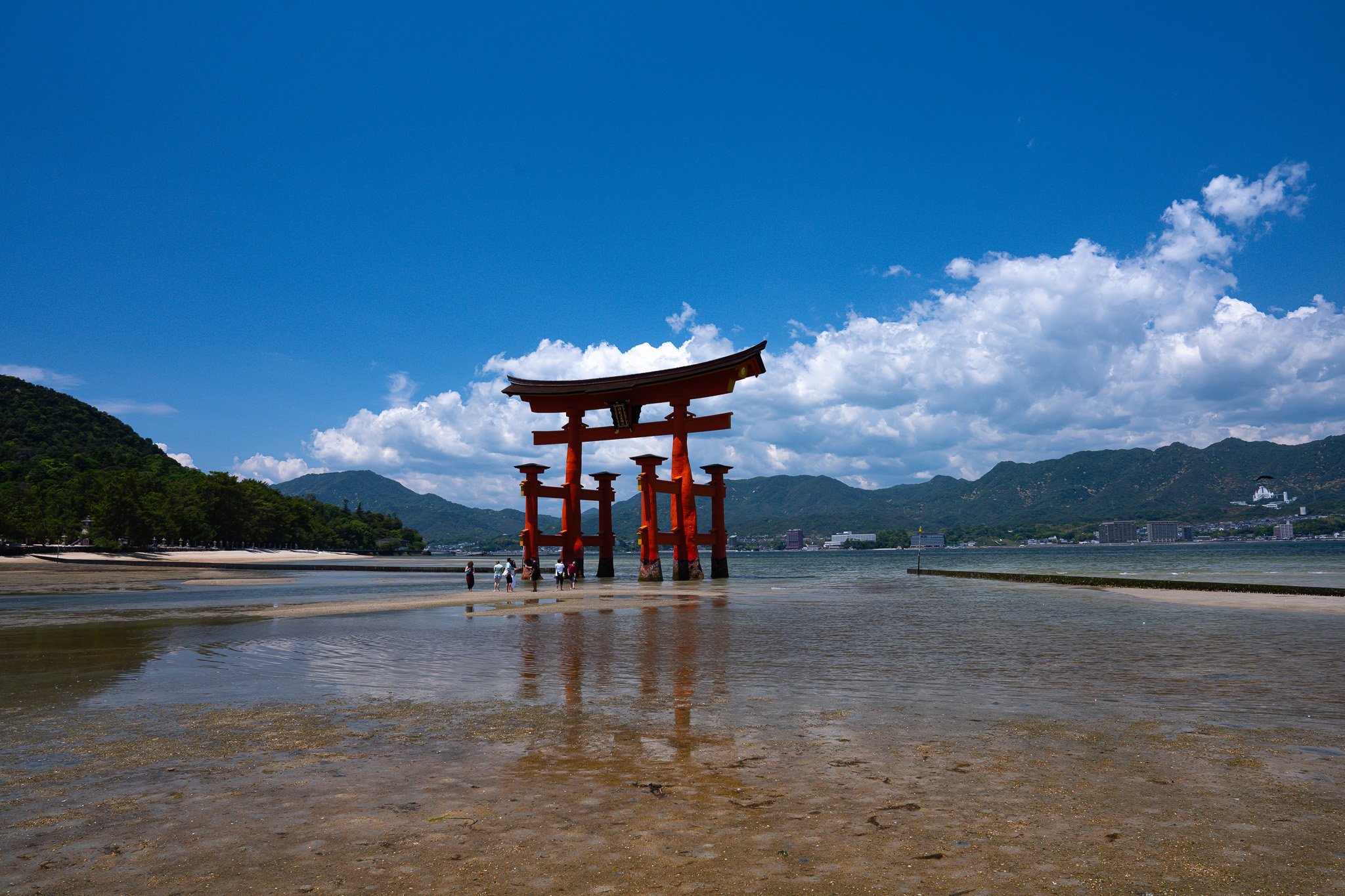
The torii was not standing alone that day.
It was standing among people who, like me, had come to see it.
Perhaps that, too, was part of the story.
Beside the torii stood Itsukushima Shrine. The famous gate was not an isolated landmark at all, but part of the shrine’s wider landscape and history.
We paused and briefly debated whether to enter. In the end, we chose not to. Kyoto still lay ahead of us, and we decided to save our deeper exploration of shrines and temples for that part of the journey.
So we retraced our steps and returned to the shopping street.
As we walked, a familiar sight appeared once again — groups of school children moving through the island in organised clusters. By this point it almost felt as though they had followed us to Miyajima, though the opposite was probably just as true.
We would continue crossing paths with school groups in many of the places we visited afterward. Their presence became part of the texture of the trip itself — a recurring reminder that we were sharing these destinations with another rhythm of travel entirely.
The air grew heavier, the warmth becoming more oppressive than comforting.
At the same time, I realised I was not feeling quite myself.
There was no fever, but a runny nose had appeared, accompanied by a tiredness that seemed disproportionate to what we had done so far. It caught me by surprise. In all my years of travelling, I had rarely been unwell on the road. I had spent long days walking through the heat of China on more than one occasion without issue. Yet here, on Miyajima, my energy seemed to be slipping away.
It was a reminder that travel is experienced not only through places, but through the condition of the body carrying us through them.
No matter how carefully an itinerary is planned, the body ultimately has the final say.
Perhaps it was a lesson for future journeys — that preparation should extend beyond tickets, hotels, and transport.
Seeking a place to rest, we wandered into one of the larger shops on the island.
It was noticeably busier than the others. Alongside the expected souvenirs, the shop specialised in freshly baked Momiji — the maple leaf-shaped cakes that have become synonymous with Miyajima. Filled traditionally with sweet red bean paste, they were everywhere on the island, but here they were being made in full view of customers.
What first attracted me was not the cakes themselves.
It was the seating.
After hours of walking, the sight of available chairs felt unexpectedly luxurious.
We settled in and allowed ourselves a longer break than we might otherwise have taken.
From our seats, we could look through a large glass window directly into the production area.
The process unfolded like a carefully choreographed performance.
A continuous chain of maple leaf-shaped iron moulds travelled slowly around a conveyor system. At one point batter was poured into the moulds. Further along, fillings were added. The two halves were brought together, sealed, and baked before emerging at the end of the line as finished cakes. A staff member inspected each one before it disappeared into its packaging.
I found myself watching far longer than I expected.
There was something strangely satisfying about seeing the entire process laid bare.
Perhaps it was because it reminded me of other factory tours and production lines I had encountered on previous travels — the vast beer production lines in Qingdao, or the croissant-making machinery at Lune in Melbourne. Different products, different scales, yet all revealing the same pursuit of efficiency and consistency.
Watching the Momiji emerge one after another, I was reminded that behind even the simplest local specialty lies a carefully refined process, repeated countless times each day.
And sometimes, slowing down long enough to watch that process can be just as memorable as the attraction itself.
We spent a good amount of time moving from one shop to another, never quite separating, always waiting for one another before continuing.
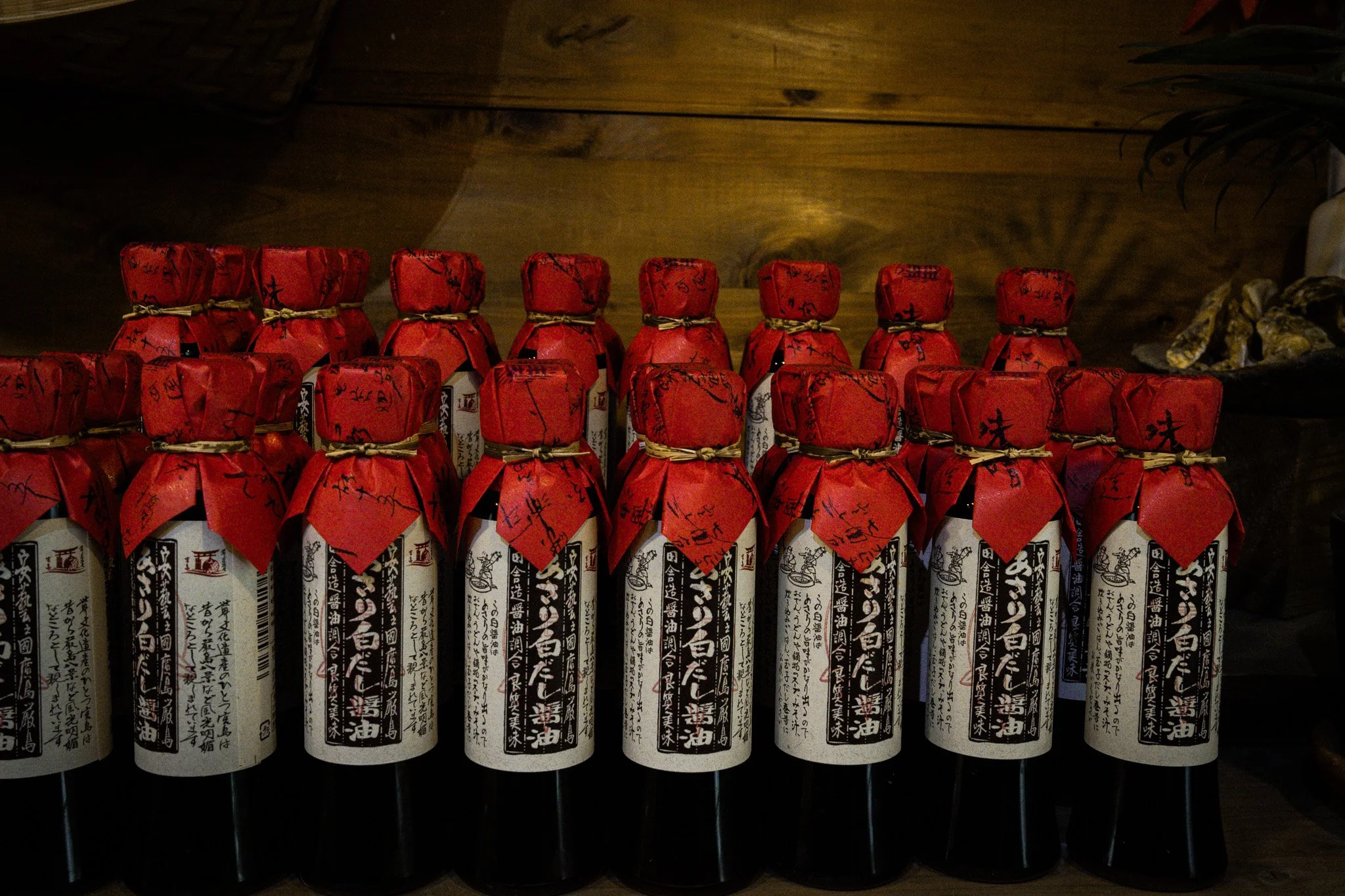
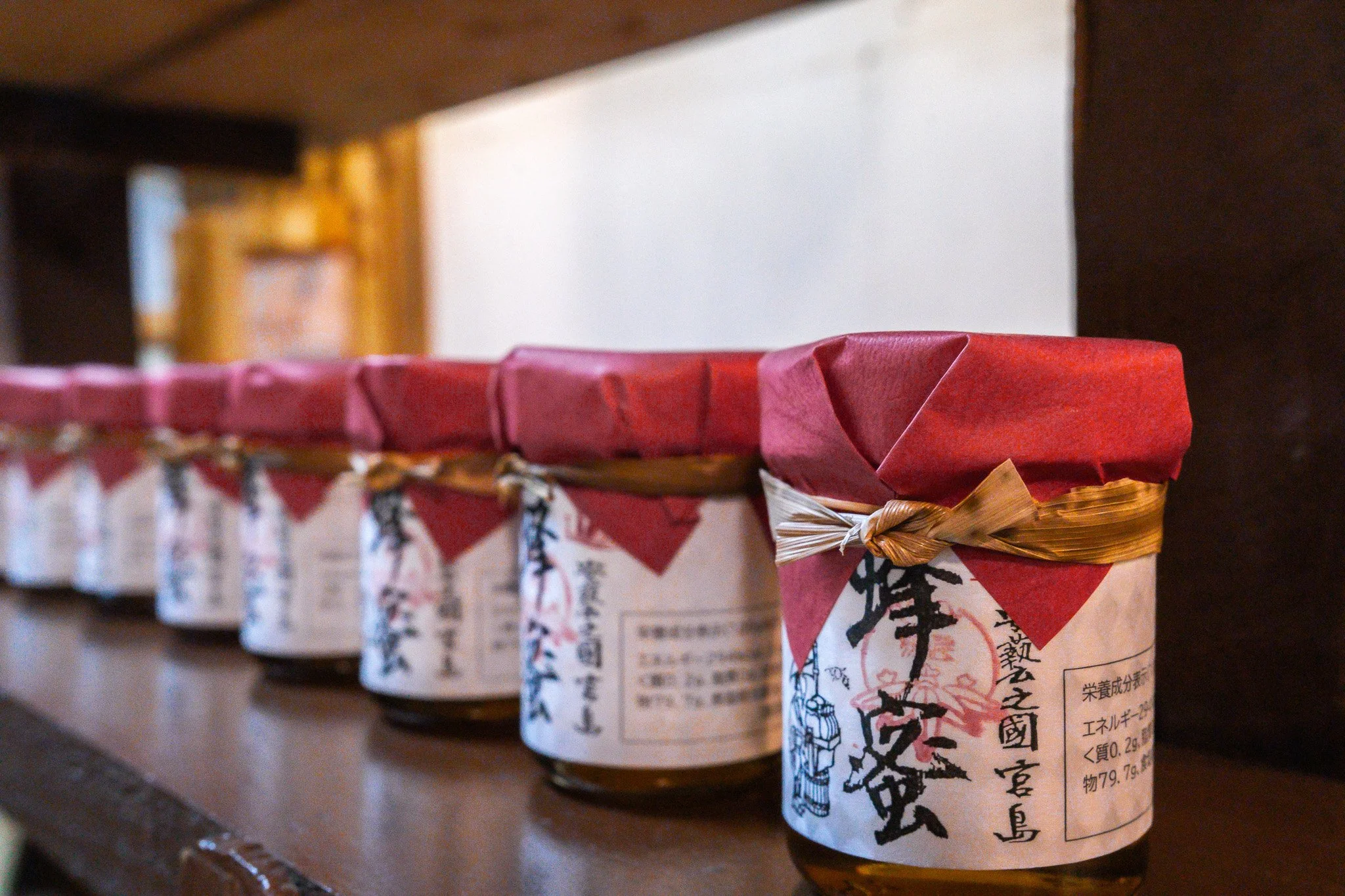
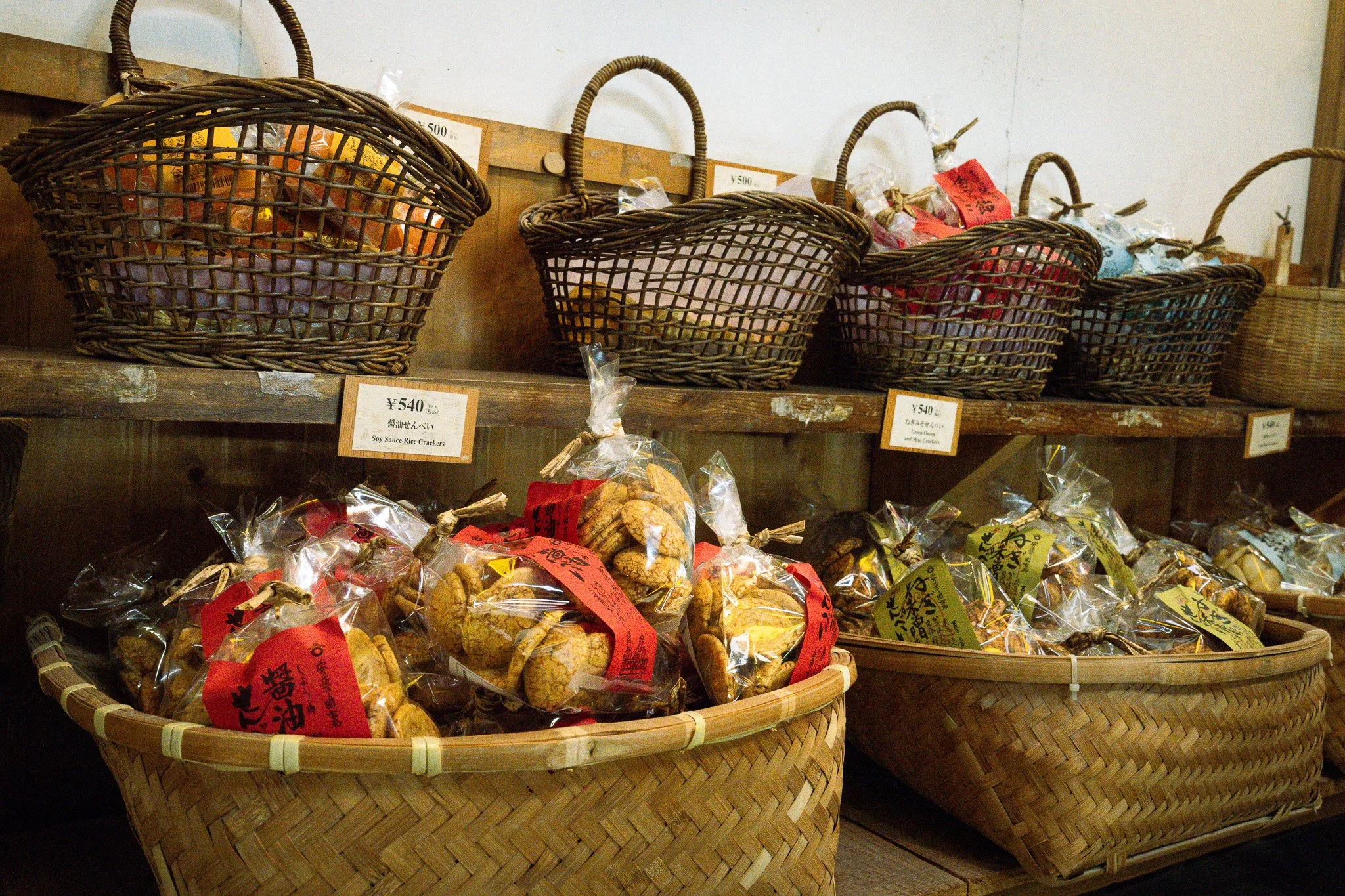
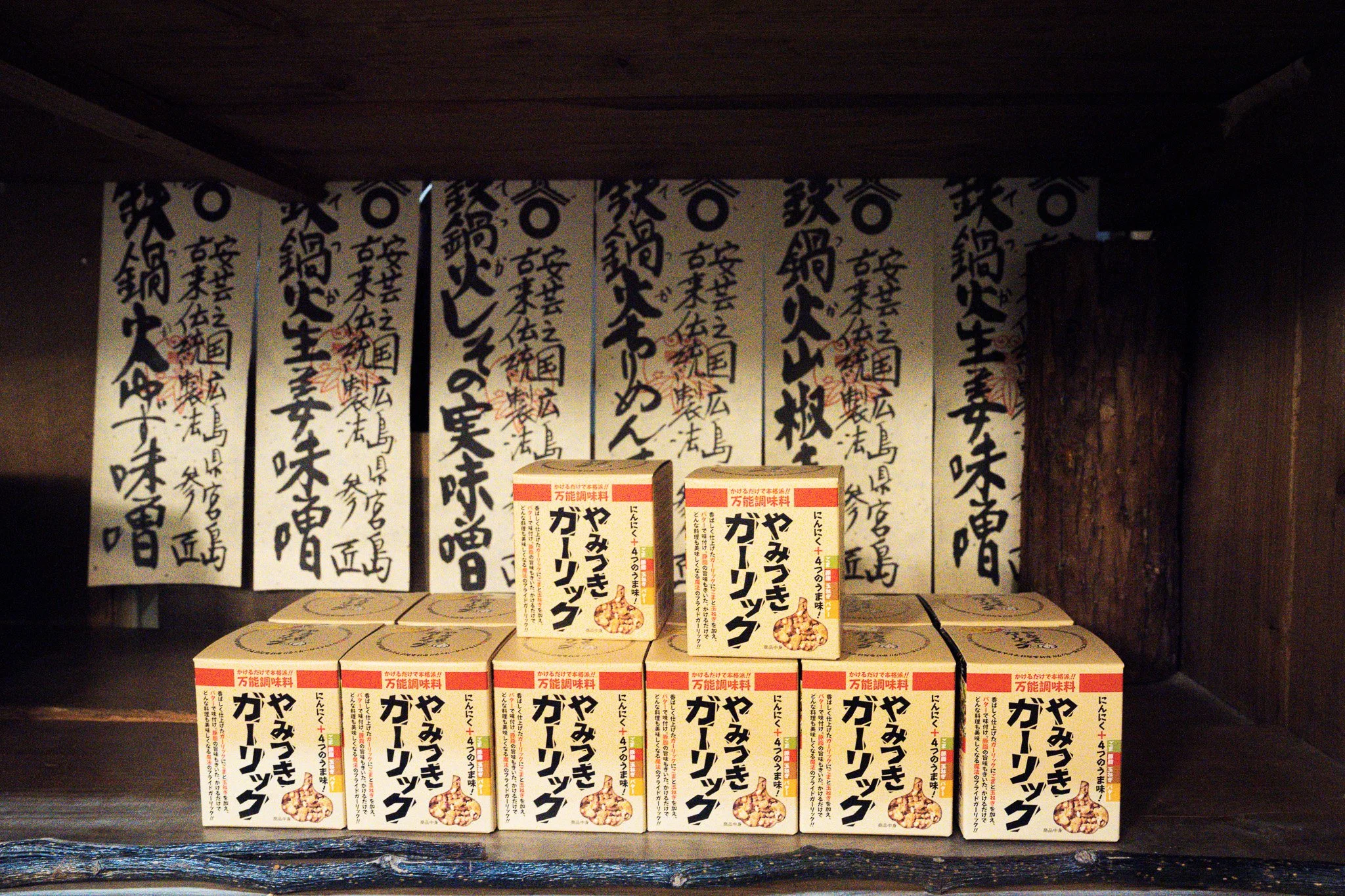
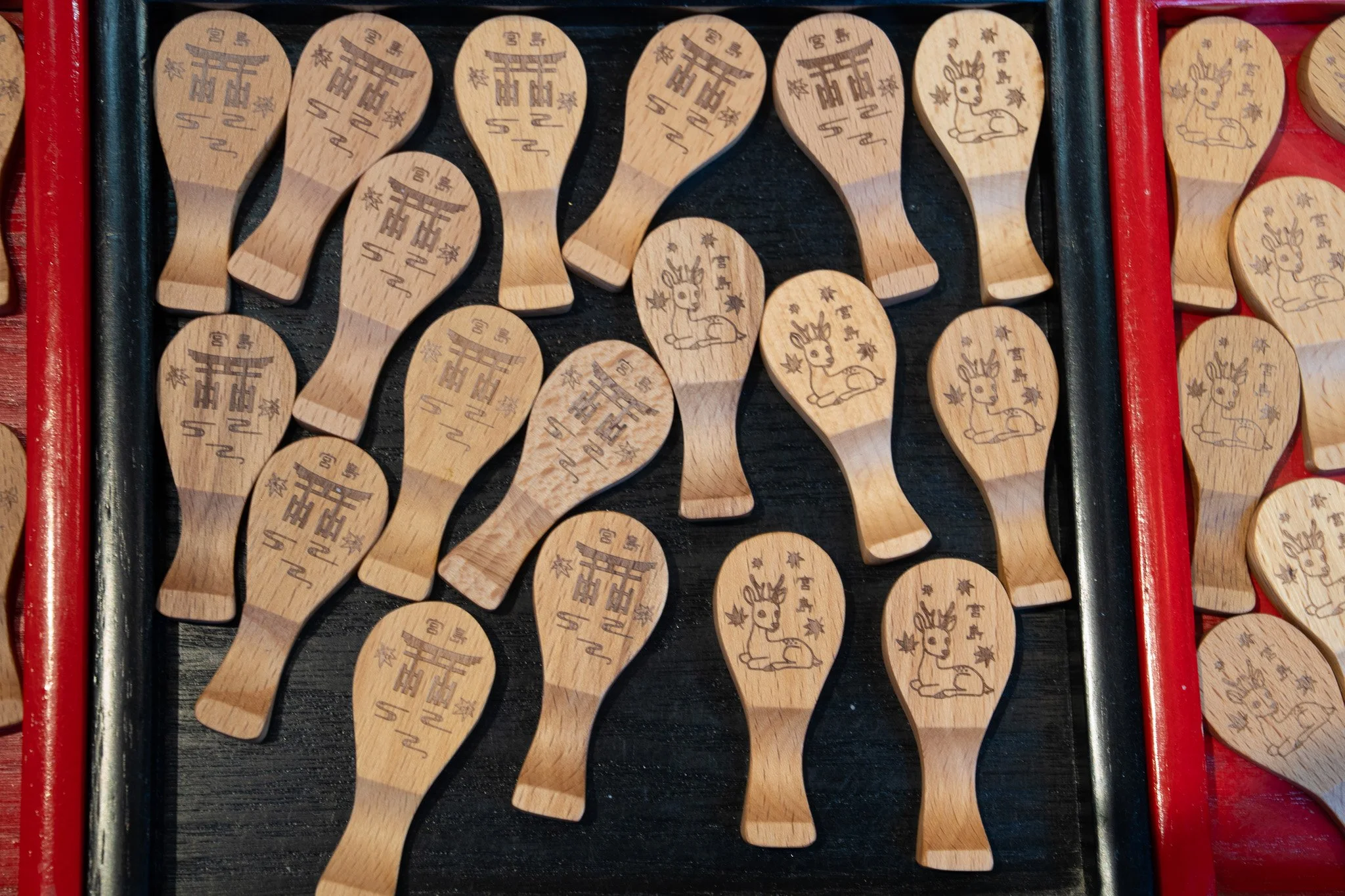
One shop in particular caught my attention — a small store specialising in wooden utensils.
It was presented as locally crafted in Miyajima, using timber from the surrounding mountains, including Yamakura, or mountain cherry wood.
Inside, the display showed the different stages of production, from raw timber to finished kitchenware. The descriptions emphasised durability, the natural grain of the wood, and its resistance to moisture.
The finished pieces were simple, but beautifully made.
Although many of them shared similar forms, each carried subtle differences in texture and grain — a reminder that even within repetition, there is individuality.
I found myself considering replacing some of our kitchen utensils at home, especially silicone ones, with something more natural. At the time, it even felt like a healthier choice.
But in the end, I did not buy anything.
Looking back, I sometimes wonder if I should have.
Yet in that moment, a quiet fatigue had already begun to settle in. It dulled decision-making in subtle ways, and I found myself moving more with the group than with my own impulses — passing through spaces rather than lingering in them.
Perhaps that, too, is part of travelling in a group.
Not every interest is fully followed to its end. Some are simply observed, then left behind as the group continues moving forward.
The first drops of rain began as we searched for somewhere to eat.
Almost instinctively, we fell into what had now become our routine — unplanned, unspoken, but strangely consistent in its pattern. The same question appeared on everyone’s mind: where are we eating, and what are we eating?
One of us would naturally take out their phone, begin searching, and without formal agreement, become the temporary decision-maker.
I was still struggling with Google Maps and the translation app on my phone. Neither seemed to work properly when I needed them most. The signal was there, but the apps refused to cooperate.
With no reliable navigation support, I quietly stepped back from the process of figuring things out and left the coordination to others who were more comfortable with it.
We weren’t walking in the rain yet — only the occasional droplet falling here and there, light enough to notice but not enough to interrupt movement. Still, there was a sense that the weather was shifting, as if the day itself was slowly preparing for something heavier.
When we arrived, it was closed.
We turned back to the main road.
At that point, the decision was no longer about what we wanted to eat, but rather what we could find that was still open — and capable of seating all six of us together.
While some of us hesitated outside, one or two of the group made a decisive move and stepped into a nearby restaurant to enquire about seating.
That small act settled the matter.
This would be our lunch.
It turned out to be a restaurant serving tempura — a dish I had been hoping to try at least once during our time in Japan. I was more than satisfied with the choice.
An added bonus was that the menu also included grilled Hiroshima oysters, something else I had wanted to experience but had not actively sought out.
There was a quiet satisfaction in that moment — the way things sometimes present themselves without deliberate pursuit, simply because circumstances align.
For me, it was a welcome pause from the fatigue that had slowly been accumulating through the day.
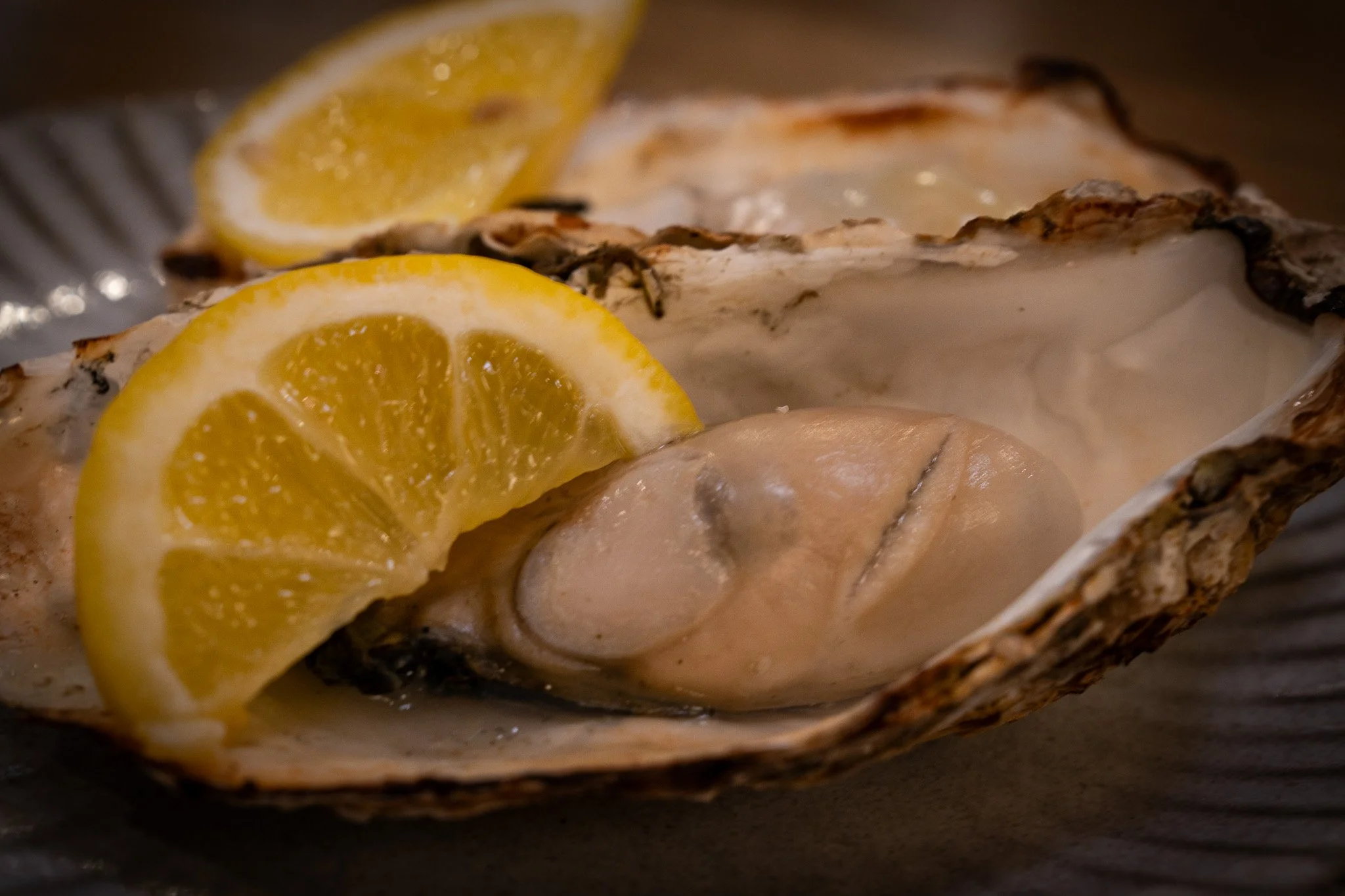
The grilled oysters were perfect. I chose the most traditional preparation — a simple squeeze of lemon to accompany them.
Just enough citrus to lift the flavour, without overpowering the natural taste of the oyster itself.
There was no trace of fishiness or sliminess, only a clean freshness that lingered with each bite.
The tempura, on the other hand, was only average. I had better in Osaka on a previous trip.
And yet, that hardly mattered.
What stayed with me was not the quality of the individual dishes, but the experience around them — the shared moment of ordering, the curiosity of seeing what each person chose, and the way the meal unfolded through conversation and small reactions at the table.
In the end, the food itself became almost secondary.
It was simply an added bonus to everything else that was happening around it.
While we were eating, even though we were indoors, we could feel the air outside shifting.
The rain had arrived properly now — earlier than predicted.
We were fortunate to be inside, warm and sheltered, as it came down with more intensity than we had expected. With no rush from the restaurant, which was not yet full, we were able to take our time finishing the meal without the usual sense of needing to vacate our seats quickly for others.
When we finally stepped outside, the rain had eased slightly into a steady drizzle. Light enough to walk through, but enough that umbrellas came up almost in unison.
I put on a poncho instead.
Under normal circumstances, I would have simply walked through the rain without much thought. But given how I was already feeling, I did not want to risk turning a mild discomfort into something more serious.
With the roads and paths now wet and potentially slippery, we decided to cut our walk short and head back.
There was still more to see on Miyajima, but for my partner and me, we had already experienced most of it on a previous visit. Ironically, the one thing we had not properly done back then was the shopping street itself. In a quiet way, it felt as though this trip had now completed that missing piece.
At one point, my poncho became an obstacle. I was refused entry into a shop because of it. A reasonable request, and I stepped aside without issue, waiting outside while the others went in. I eventually took it off later before boarding the ferry, but by then I was no longer inclined to revisit that particular shop.
As we made our way to the torii earlier on the day, one storefront — or perhaps a small restaurant — drew my attention, not for what it offered inside, but for what was at its entrance.
A fully grown deer was lying calmly at the doorway, as if it belonged there, as if it had always been part of the threshold itself.
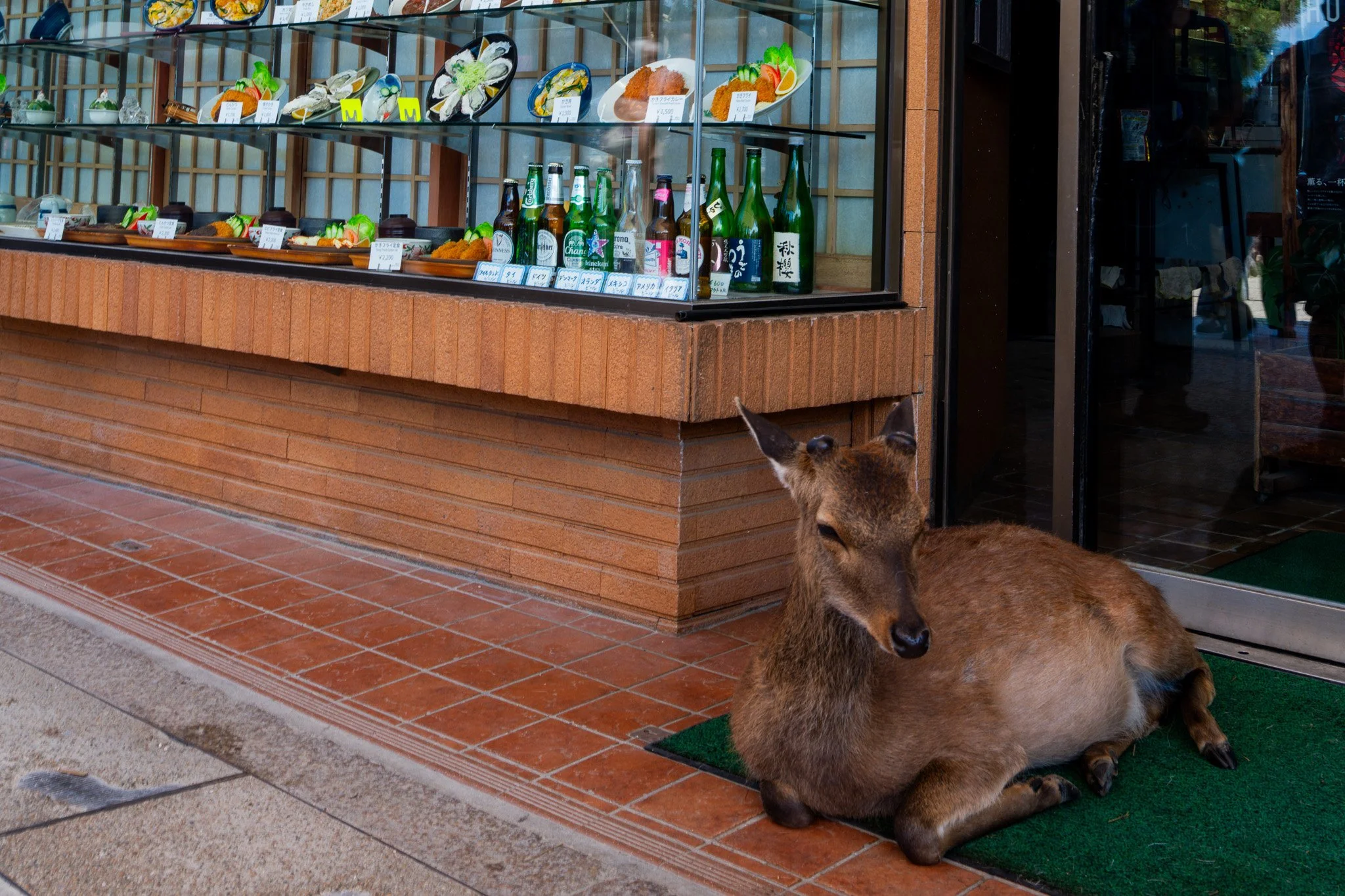
It remained there when we passed again on the way back to the ferry, unmoved and unbothered, while everything around it continued to flow.